
Industry 4.0 and smart factory: what the programme actually involves
The terms mean overlapping things, and none of them tells you what is being proposed. What these programmes consist of in practice, why they fail organisationally rather than technically, and what they actually cost.
In short
- Ignore the label, look at the proposal. Ask what decision it supports and who would make it.
- The work is mostly organisational. Agreeing what a number means is harder than measuring it.
- Start with a problem that costs money, not with a platform or a maturity assessment.
- One named owner with authority to decide, or the programme drifts regardless of the technology.
- Budget past the build. Programmes run out of funding exactly when they become useful.
The terms, briefly
Industry 4.0, smart factory, smart manufacturing and digital transformation are used to mean overlapping and largely interchangeable things. Time spent distinguishing them is time wasted; what follows is enough to translate a proposal.
- Industry 4.0 is the broadest and the most political, originating as a German industrial policy programme. It describes connected, data-driven manufacturing generally.
- Smart factory narrows it to one site: equipment that reports what it is doing, and systems that use that.
- Smart manufacturing is used similarly, more often in North America.
- Digital transformation is the widest and the least specific, covering anything from replacing paperwork to redesigning a business model.
- Industrial IoT is the part of this that gets data out of equipment. It is the most concrete of the terms because it names an engineering activity.
The practical consequence is that none of these words tells you what is being proposed. Two suppliers offering “a smart factory solution” may be offering a sensor kit and a business-process programme respectively. The question that resolves it is not which term they used but what decision would be made differently, and by whom.
IIoT and IoT
Worth separating because the distinction is real. The difference is not the technology but the consequences and the lifespan. A consumer device is replaced every few years, tolerates an occasional fault and lives in a comfortable environment. Industrial equipment runs for a decade or more, sits in heat, vibration, dust and electrical noise, and its failure can stop production or create a hazard.
That changes how carefully each decision has to be made, how long support must be provided, and how much margin every part of the design needs. It does not change the underlying idea, which is measuring something and acting on the result. The engineering detail is in what industrial IoT actually is.
What these programmes actually consist of
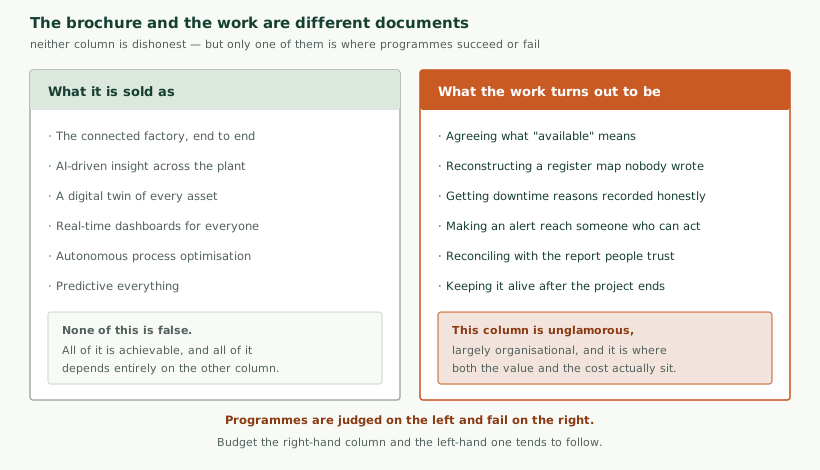
The left-hand column is achievable and none of it is a lie. The difficulty is that it describes outcomes, while the right-hand column describes the work — and budgets, timelines and expectations are almost always built from the left.
A concrete illustration. A plant wants to know its overall equipment effectiveness. The technical work — reading counters and states from controllers, computing three numbers, displaying them — is perhaps a fifth of the effort. The rest is establishing whether a planned changeover counts against availability, whether a machine at reduced speed is available, whether rework counts as production, when a shift begins, and which of the two existing reports the answer should match. None of that is engineering, all of it must be settled before the figure means anything, and it cannot be settled by the supplier alone.
What the technology actually consists of
Stripped of the vocabulary, the technical content of these programmes is a short list. Knowing it makes proposals easier to evaluate, because a proposal is generally some subset of this.
| Component | What it does | When you need it |
|---|---|---|
| Getting data out of equipment | Reading controllers, or measuring externally where there is nothing to read | Always. This is the foundation. |
| A gateway at the site | Speaks the equipment’s protocols, buffers through outages, reduces what is sent | Where a network outage must not lose data, or decisions must work offline |
| Somewhere to keep it | Time-series storage, with retention and aggregation | Always, though an existing historian frequently serves |
| A way to see it | Dashboards for the floor, reports for management | Always — but built for a named decision, not for a demonstration |
| Alerting | Telling someone when something needs attention | Where a response is possible and somebody is accountable |
| Integration with business systems | Feeding MES, ERP or maintenance systems | Where figures must join existing reporting |
| Analysis or machine learning | Finding patterns a threshold would miss | Later, and only where the signal is genuinely complex |
| Simulation or a digital twin | Testing a change before making it | Rarely, and genuinely valuable when the change is expensive |
Two observations. The first four rows cover the great majority of the value in most programmes, and they are the least discussed in marketing material. And the last two rows are where the vocabulary concentrates — a proposal weighted toward analysis and simulation, before the first four are solid, is proposing the roof before the walls.
The corresponding engineering detail is in what industrial IoT actually is, industrial edge gateways, cloud backends and dashboards and edge AI.
Where programmes go wrong
The failure modes are consistent enough to list, and almost none of them is technical.
| How it fails | What actually happened | What would have prevented it |
|---|---|---|
| Pilot succeeds, nothing scales | The pilot depended on a helpful engineer and a cooperative machine | Choosing a difficult first site rather than an easy one |
| Dashboards nobody opens | Built for a demonstration, not for a decision | Naming the decision and the person before building |
| Figures nobody believes | Definitions never agreed; two systems disagree | Settling definitions before collecting, not after |
| Data collected, never used | No capacity to interpret; no route to act | Budgeting the response side, not only the capture |
| Valuable in year one, ignored by year three | The person who cared moved on | A named owner, and an hour a month of deliberate upkeep |
| Platform bought, problem unchanged | Technology selected before the requirement was understood | A survey and a defined problem first |
| Stalled at procurement | Network, access and warranty questions raised late | Involving OT and the machine builders at the start |
| Delivered, then quietly bypassed | It made someone’s job harder without making it better | Asking the operators what would help them |
The last row deserves expansion because it is the least discussed. A system that requires an operator to enter data and gives them nothing back is a tax on their time, and it will be filled in carelessly or not at all. The single most effective thing a programme can do for data quality is make the data visibly useful to the people supplying it — which usually means showing them something they wanted to know anyway.
Which problem to pick first
The choice of first problem shapes everything afterwards, and the instinct — pick the biggest problem — is usually wrong. The biggest problem is generally the hardest, and failing at it publicly ends the programme.
Better criteria for a first project:
- It costs money that somebody can name. Not “we lack visibility” — a line that stops, a bottleneck, an energy bill.
- The measurement is achievable without heroics. If it needs a shutdown, a controls project and three approvals, it is the wrong first one.
- Somebody already wants the answer. An internal advocate who will use the result is worth more than a technically easier problem nobody cares about.
- A result is visible within a quarter. Programmes lose support in the gap between funding and evidence.
- It generalises. Solving it should teach you something applicable to the next twenty machines.
- Failure is survivable. If the first project must succeed, it will be declared successful whatever happens, and the organisation will learn nothing.
Two candidates meet these criteria unusually often. Energy measurement at the supply requires no change to production, no shutdown and no cooperation from a machine builder, and it usually finds consumption outside production hours that nobody had quantified. And downtime measurement on one problem line answers a question people already argue about, which guarantees an interested audience.
The common thread is that both produce a number somebody was already guessing at. Replacing a guess with a measurement is a visible result, and it is what earns the programme its second phase.
A sequence that works
- Name a problem that costs money. A line that stops unpredictably, a bottleneck whose real utilisation nobody knows, an energy bill nobody can explain. Not a technology, and not “we should have data”.
- Survey what exists. What controllers are installed, what interfaces they already have, what your existing systems already record. This regularly finds that a substantial part of what was going to be specified is already being collected and ignored.
- Agree the definitions with the people who will use the figures. Weeks of elapsed time, little effort, and the step that cannot be retrofitted.
- Instrument a few representative machines — representative meaning informative, not accessible.
- Set criteria in advance for what would justify extending and what would mean stopping. Both, before results exist.
- Run in parallel with the existing method for a defined period, and explain the differences rather than adjusting either.
- Then extend, with consistent naming and configuration from a template.
Steps three and six are elapsed time rather than effort, and they are the two most often compressed. Both involve waiting for people to agree, which cannot be accelerated by adding engineers.
What to do in the first ninety days
For an organisation that has decided to start but not what to start with, a concrete plan is more useful than a strategy.
| Weeks | What happens | What it produces |
|---|---|---|
| 1–2 | Walk the plant. List what is installed, what interfaces exist, what is already recorded somewhere. | A survey document, and usually a surprise about what is already collected |
| 1–2 | Read the maintenance records for the last two years. What failed, how often, what it cost. | A ranked list of problems that actually cost money |
| 3–4 | Pick one problem. Name the decision it would change and who makes it. | A scope small enough to finish |
| 3–6 | Agree definitions with the people who will use the figures. Involve the works council where one exists. | Written definitions, dated |
| 5–8 | Instrument two or three representative machines. Set up the data path. | Data arriving, with known meaning |
| 7–10 | Introduce downtime reason capture. Make it fast, and show the results back. | The context that makes the rest interpretable |
| 9–12 | Run parallel with the existing method. Explain differences. | Figures people believe, or a known reason they differ |
| 12 | Review against the criteria agreed in week 4. | A decision to extend, adjust or stop |
Two features of that plan are deliberate. The first four weeks produce no technology at all, and they are what prevent the remaining eight being spent on the wrong thing. And week twelve includes the possibility of stopping, assessed against criteria written before anyone knew the results — which is the difference between a pilot and a commitment that nobody can now question.
The survey usually changes the plan
Worth stating separately because it happens so consistently. A survey of what already exists typically finds some combination of: a historian recording tags nobody reads, controllers with an OPC UA server that was never switched on, energy meters installed and never connected to production data, IO-Link sensors reporting diagnostics the controller discards, and a spreadsheet somebody maintains that already answers part of the question.
Each of those converts a proposed purchase into a configuration task. It is common for a survey costing a week or two to remove a substantial fraction of a proposed scope — and the remaining work is better for fitting into what exists rather than sitting beside it.
Measuring whether it worked
A programme that cannot show its effect loses its budget at the next review, and the honest way to show it is decided at the start rather than argued afterwards.
- Record the baseline before changing anything. Whatever measure the programme is meant to improve, capture it for a period first. Without that, any later figure is an assertion.
- Count interventions that happened because of the system. Not estimated savings — specific cases, with what was found and what would plausibly have happened otherwise, marked as the judgement it is.
- Track planned against unplanned work. A shifting ratio is a real and easily collected indicator.
- Count the misses too. Failures the system did not anticipate are a gap in the measurement design, not a failed programme, and reporting only successes destroys credibility at the first miss.
- Ask the users. Whether the people meant to act on it find it useful is a legitimate measure, and it predicts survival better than any number.
These four or five figures side by side after a year give an honest account. It is almost always more persuasive than vendor percentages, because it comes from your own plant and because its limits are visible.
Scaling past the first success
A successful pilot creates a different problem, and the difficulties on scaling are predictable enough to plan for.
- Consistency becomes essential. An installation fitted carefully by someone who understood the intent does not generalise to fifty fitted by whoever was available. Documented mounting and configuration standards are what make comparison across machines meaningful.
- Configuration effort grows faster than the estate. Establishing a baseline per machine is trivial for three and substantial for a hundred. Templating decides whether a site-wide rollout is sustainable.
- Alert volume multiplies. A rate that was comfortable across three machines becomes overwhelming across a hundred.
- Definitions have to be shared. Two areas computing the same measure differently cannot be compared, and somebody will compare them anyway.
- Someone has to own it. Thresholds drift, sensors fail, products change, new equipment arrives.
The economics of the rollout are decided on the second site, not the first. If adding a site is a templated operation, the programme scales; if it requires an engineer to configure each one by hand, cost grows linearly and the rollout usually stops partway. Building the second site’s process while doing the first is what makes the difference.
The organisational side
Since most of the difficulty is organisational, it is worth being specific about what that means.
One named owner. Not necessarily doing the engineering, but holding the objective, deciding between competing proposals, and keeping the programme alive when attention moves elsewhere. Programmes without that person drift regardless of how good the technology is, and the commonest single cause of a system that was valuable in year one and ignored by year three is that this person moved on and nobody inherited it.
OT and IT both represented, with their differences acknowledged. Operational technology values availability above nearly everything; information technology values patching currency and confidentiality. Both positions are correct within their remit, and most integration friction comes from treating one as obstruction. The boundary design that resolves this is covered in OT/IT integration.
The people who will use the figures, early. Definitions decided without them produce numbers that get argued with rather than acted on.
The operators. They hold information no sensor provides — why a machine actually stopped — and their cooperation is the most fragile input in the whole system.
Where a works council exists, systems capable of monitoring employee performance may be subject to co-determination regardless of whether such monitoring is intended. This is particularly relevant in Germany and is covered in the German article on Maschinendaten erfassen und auswerten. We are not legal advisers; the point is that it affects planning and that aggregating to machine and shift rather than to individual usually resolves most of it.
Security is part of the programme, not an afterthought
Connecting equipment that was previously isolated changes the security position, and it is worth being explicit about that at the start rather than answering it under pressure during procurement.
The principle is a single deliberate crossing point, with data flowing upward and no path allowing the business network to reach a controller. In practice that means segmentation with an enforced boundary, outbound-only connections so nothing needs opening inbound, read-only access to controllers unless a write path is genuinely required, and no temporary exceptions left in place after commissioning — the last being the single most common finding in plants that believe themselves segmented.
Two further points specific to programmes rather than to individual devices. Each new connection is a permanent obligation, so connecting everything because it is technically possible creates maintenance and exposure without corresponding value; build the paths with a named consumer. And the equipment you connect may have obligations of its own — connected products placed on the market are increasingly subject to security requirements with duties across their whole life, covered in security regulation for connected products.
Raising this early also tends to help the programme rather than slow it. A proposal that arrives with a boundary design attached is far easier for IT and OT to approve than one that raises the question after the equipment has been ordered. The detail is in OT/IT integration.
The skills question
A recurring anxiety is that these programmes require capabilities the organisation does not have. Partly true, and less than feared — but the gaps are not usually the ones people expect.
| Capability | Needed for | Realistic source |
|---|---|---|
| Knowing the machines | Everything. Nothing substitutes for it. | Internal, and cannot be bought in |
| Controls and instrumentation | Getting data out safely and correctly | Internal if you have it, otherwise contracted |
| Integration and data engineering | Moving data and making it interpretable | Frequently contracted, at least initially |
| Analysis of the results | Turning figures into decisions | Internal — it needs process knowledge |
| IT operations | Keeping servers and networks running | Internal IT, with OT’s constraints understood |
| Data science | Only where the signal is genuinely complex | Later, if at all. Frequently not needed. |
The first and fourth rows are the ones that matter and the ones that cannot be outsourced. Knowing why a particular machine behaves as it does, and being able to judge whether a figure is plausible, are process knowledge — an external team will never have it, and a programme that depends on them having it will produce confident nonsense.
The row people worry about most, data science, is the one least often needed early. A well-chosen measurement with a sensible per-machine threshold catches a great deal, is explainable and is easy to trust. Hiring for machine learning before the first three rows are covered is a common and expensive sequencing error.
The practical arrangement for most organisations: contract the integration and data engineering initially, keep the machine knowledge and the interpretation internal, and plan the handover from the start so the capability transfers rather than the dependency deepening. The commercial side of that is covered in choosing a development partner.
Buying, building, or neither
A question that arrives early and is frequently answered before the requirement is understood.
| Route | Suits | Costs |
|---|---|---|
| Platform product | Fast to a working system; answers whether the data is useful at all | Per-device or per-tag pricing at scale; the vendor’s data model; migration difficulty later |
| Machine builder’s portal | Deep insight into that specific machine, no effort from you | One portal per manufacturer; no overall picture; export often limited |
| Built around your own data model | Control over cost, architecture and history | You build and operate it |
| Extending what you already have | Frequently the cheapest genuine improvement | Requires knowing what you already have |
The last row is the one most often skipped and most often correct. Plants with a historian, an MES or an existing data collection system commonly find that the gap is not missing data but unread data. Establishing that before specifying anything is a week of work that regularly removes a large part of the proposed scope.
Where a platform is chosen, two questions settle whether the decision is reversible: can we export our data in bulk in a usable form, and what happens to it if we stop paying. Keeping your own naming and data model rather than adopting the vendor’s preserves the option to move without committing to it.
Getting the funding conversation right
These programmes are frequently funded on the wrong basis, which sets them up to be judged against a promise nobody could have kept.
The pattern to avoid: a business case built on a vendor percentage, approved as a single capital sum, with a benefit expected within the financial year. That combination produces pressure to show results before the baseline has even settled, and it has no line for the ongoing ownership that determines whether the system survives.
What tends to work better:
- Fund a first phase that can fail. Small enough to approve without ceremony, with criteria agreed for extending or stopping. This converts an argument about projected benefits into an experiment with a defined cost.
- Build the case on named losses, not percentages. “This line stopped for 40 hours last year and we do not know why” is a stronger case than any industry figure, and it is checkable.
- Include the recurring lines explicitly. Ownership, licensing at full scope, and the time of whoever acts on the output. A case without them is understated in a way that will be discovered later.
- Separate the phases. Approving a site-wide rollout before the first site has produced a trusted number commits money against an untested assumption.
- Say what you will measure to judge it, before starting. Baseline first, then change.
There is also an argument worth making plainly to whoever holds the budget: a measurement that shows a proposed investment is unnecessary has paid for itself many times over. A plant convinced it needs an additional machine, where a few weeks of utilisation measurement shows the existing ones are not the constraint, has avoided a capital purchase for the cost of some instrumentation. That outcome rarely appears in a business case, and it is among the most common genuine results.
What it costs, in shape
Figures depend on the site. The distribution is consistent and is not where people expect.
| Item | Nature | Notes |
|---|---|---|
| Survey and discovery | Small, one-off | Consistently pays for itself by removing scope |
| Sensors and instruments | Small to moderate | The item everyone budgets for |
| Installation and access | Large | Shutdown windows and access equipment dominate |
| Integration with existing systems | Large | Getting data where decisions are made |
| Agreeing definitions | Small effort, long elapsed | Mostly meetings; compressed more than any other step |
| Software and licensing | Varies enormously | Per-tag models scale unpleasantly. Price at full scope. |
| Ongoing ownership | Recurring | Small, and its absence is why programmes decay |
| Capacity to act | Recurring | Detection without response capacity produces reports, not value |
The two recurring items are what a programme actually commits you to, and they are the ones missing from most business cases. A useful discipline is to estimate them annually and ask whether anyone is prepared to fund that for five years. If not, the programme should be smaller.
A worked situation
A mid-sized manufacturer, around 200 staff, one site, machines spanning three decades. The managing director has been told the company is behind on Industry 4.0 and has budget for a programme. Nobody internally has done this before, and three suppliers have proposed platforms.
What we would suggest, and why:
- Do not select a platform yet. All three proposals assume a requirement nobody has written down. Selecting now fixes an architecture around assumptions.
- Two weeks of survey. What controllers exist, what interfaces they have, what the existing systems already record. Expect to find at least one source of data already being collected and ignored.
- An afternoon with the maintenance records. What has actually failed, how often, what it cost. This reorders the priority list more than any workshop.
- Name one problem. Probably the line that stops unpredictably, because people already argue about it and the answer will be used.
- Settle definitions with production, planning and whoever presents the monthly figures.
- Instrument three machines on that line, plus energy at the supply because it is nearly free to add and frequently pays for the phase on its own.
- Introduce downtime reasons, with fewer than a dozen options and immediate visible feedback to the operators.
- Review at twelve weeks against criteria agreed in week four.
The likely outcome, based on how these usually run: the survey removes part of the proposed scope because something useful already exists; the downtime measurement shows that short stops nobody logged account for more lost time than the breakdowns everyone discusses; and the bottleneck turns out to be a different machine from the one assumed.
At that point the platform question can be answered properly, because there is now a requirement to answer it against. It may well be that one of the three original proposals is right — but it will be chosen for a reason, and scoped to something real.
What this sequence deliberately avoids is the most common failure in this situation: spending the budget on a capable platform, connecting everything to it, and discovering a year later that the figures are not trusted because nobody agreed what they meant.
Claims worth questioning
- “Industry 4.0 readiness assessment.” Frequently a document that produces no change. What is actually useful is a survey of what exists and what is measured, which is cheaper and more concrete.
- “End-to-end digital transformation.” Ask which decision changes on Monday. If there is no answer, the scope is not yet real.
- “Digital twin of your factory.” Genuine and useful in specific cases such as simulating a proposed line change. Frequently used to mean a three-dimensional view of live data, which is a dashboard.
- “AI-driven optimisation.” Ask what it was trained on and what it does when conditions change. A great deal of value comes from a well-chosen measurement with a sensible threshold, which is explainable and easy to trust.
- “30 to 50% improvement.” Drawn from studies of plants that were measuring nothing. A plant already running competently will see a smaller change.
- “Deploy in weeks.” The installation may be quick. Agreeing definitions, establishing baselines and building trust in the figures are not, and they determine whether anything is used.
A reasonable test of any supplier, ourselves included: ask what they would not do, and what would make them recommend a smaller project. An answer naming real limits is worth more than one naming none.
When the answer is not a programme
Occasionally the honest conclusion is that a digitalisation programme is not what would help, and the signs are recognisable enough to name.
- The problem is known and unaddressed. If everyone can already name the cause of the losses and nothing has been done, measuring it again produces a better-documented version of the same inaction.
- There is no capacity to act. A plant that cannot fit in the planned work it already has will not act on new alerts either. Detection without response capacity produces reports.
- The basics are not in place. Where planned maintenance is not happening, lubrication is disorganised or the spares situation is the real constraint, fixing those is cheaper and more effective than instrumenting the consequences.
- The site is closing or being rebuilt. Instrumentation on equipment being replaced within eighteen months rarely repays.
- It is being done because it should be done. A programme without a named problem and a named beneficiary will produce a system nobody uses, and the organisation will conclude the technology does not work.
We say this knowing it sometimes means a smaller engagement or none. A programme started for the wrong reasons is shut down within two years, which is a worse outcome for both parties than an honest conversation at the start.
A short glossary
| Term | Meaning |
|---|---|
| Industry 4.0 | Broad term for connected, data-driven manufacturing. Originated as industrial policy; now used loosely. |
| Smart factory | The same idea narrowed to one site. |
| Digital transformation | The widest and least specific of the terms. Ask what it means in a given proposal. |
| Industrial IoT | The part that gets data out of equipment. The most concrete term, because it names an activity. |
| Digital twin | A model of an asset or process used to simulate changes. Genuine and useful; frequently used to mean a 3D dashboard. |
| OEE | Overall equipment effectiveness: availability, performance and quality combined. Only meaningful once its definitions are agreed. |
| Brownfield | Existing plant, as opposed to a new build. The normal case, and harder. |
| Maturity model | A framework rating how advanced an organisation is. Produces a document; rarely produces a change. |
| Unified namespace | A pattern where systems publish to one place under agreed naming rather than connecting to each other. |
| Minor stop | A short interruption resolved without a record. Usually the largest invisible loss in a plant. |
If you take one thing away
The label does not matter. What matters is whether a proposal names a decision that would be made differently, a person who would make it, and a number that person would trust.
Proposals that answer those three questions tend to work regardless of what they are called. Proposals that cannot answer them tend to produce a system that is admired at the launch and bypassed within two years — and the organisation usually concludes that the technology was the problem, which it almost never was.
How we help with this
We do the engineering: surveying what exists and what is already measured, getting data out of equipment and into the systems that use it, agreeing naming and definitions with the people who will use the figures, and documenting it so you are not dependent on us afterwards.
We do not sell a platform, which means we have no reason to recommend one when extending what you already have would serve you better — and in our experience that is the right answer more often than the market suggests. Where the honest conclusion is that a smaller piece of work, or none, would serve you better, we would rather say that than take the project.
Related reading: what industrial IoT actually is for the engineering, retrofitting legacy machines for equipment you already own, OEE and energy monitoring for the measures these programmes usually target, OT/IT integration for connecting to business systems, and choosing a development partner for the commercial side. Services: industrial IoT integration.
Questions we are asked about this
What clients ask before starting
What is the difference between IoT and industrial IoT?
Mostly the consequences of failure and the lifespan. Consumer connected products are replaced every few years and a fault is an inconvenience. Industrial equipment runs for a decade or more, sits in heat, vibration and electrical noise, and a failure can stop production or create a hazard. The underlying idea is the same; what changes is how carefully each decision has to be made and how long the result has to keep working.
Is Industry 4.0 a real thing or marketing?
Both, and the useful response is to ignore the label and look at what is being proposed. The term describes a genuine shift — equipment that reports what it is doing, and decisions made from that rather than from recollection. It also gets attached to almost any proposal involving a screen. Ask what decision a system would support and who would make it; that question separates the two immediately.
Where should a digitalisation programme start?
With a problem that costs money now, on a small number of representative machines, for a defined period, with agreed criteria for what would justify extending and what would mean stopping. Starting with a platform, a technology or a maturity assessment is the most reliable way to spend a year and have nothing anyone acts on.
Do we need a maturity assessment first?
Rarely, and they tend to produce a document rather than a change. Their appeal is that they feel like progress without requiring a decision. If one is useful at all, it is as a short internal exercise to establish what you already have and what is actually measured — which is a survey, and a survey is cheaper and more concrete than an assessment framework.
How long before a programme shows results?
Measurement and alerting on departures from normal usually become useful within months. Anything requiring accumulated history takes considerably longer. What takes longest, and is consistently underestimated, is agreement about what the numbers mean — that is elapsed time waiting for people, and it cannot be shortened by adding engineers.
Should we appoint a head of digitalisation?
A named owner is essential; a separate function frequently is not. What matters is one person with authority to decide between competing proposals, hold the objective and keep the programme alive when attention moves elsewhere. Placing that with someone who already owns operational results usually works better than creating a parallel structure that has to negotiate for cooperation.
What does a programme like this cost?
The shape is more useful than a figure, and it is not where people expect. Sensors and software are rarely the largest items; installation, integration with what you already run, agreeing definitions and the ongoing ownership dominate. A budget that covers only the build tends to run out exactly when the system starts being useful.
What do you actually provide?
Survey of what exists and what is already measured, the engineering to get data out of equipment and into the systems that use it, agreement on naming and definitions with the people who will use the figures, and documentation handed over so you are not dependent on us. We do not sell a platform, and where the honest answer is that a smaller piece of work would serve you better, we would rather say so.
What decision would you make differently with better data?
Tell us what the problem costs you today and what you already measure. If the honest answer is that a smaller piece of work would serve you better, we would rather say so early.