
Tank level, cold chain and water quality monitoring
Where the measurement is the deliverable rather than an indicator of something else. What defeats each level technology, where a cold chain sensor belongs, why fouling dominates water quality, and why calibration is the whole programme.
In short
- The measurement is the deliverable here, not an indicator of something else. Accuracy and drift matter in a way they do not on a vibration trend.
- Foam defeats more level measurements than anything else, and is the condition least likely to be mentioned beforehand.
- Calibration is the whole programme. An uncalibrated instrument produces confident numbers that stopped being true at an unknown point.
- Air temperature is not product temperature. Most cold chain false alarms come from measuring the wrong one.
- Where a record matters, the audit trail is the requirement, not the alert.
How this differs from monitoring machines
Condition monitoring asks whether a machine is degrading. The measurement is a proxy: nobody cares about the vibration figure itself, only what it implies, and an error of ten percent rarely changes the conclusion because the signal of interest is a change over time.
Process and environmental monitoring is different in a way that changes the engineering. Here the measurement is the thing. A tank level determines whether a delivery is ordered, a storage temperature determines whether product is saleable, a discharge reading determines whether a consent is met. The absolute value matters, an error of a few percent can be the difference between compliance and breach, and the consequences of being quietly wrong can be considerably worse than having no measurement at all.
Three consequences follow, and they shape everything below:
- Calibration and drift stop being maintenance details and become the central problem. A machine-monitoring sensor that drifts slowly is a nuisance; a product-temperature sensor that drifts is a recall.
- Conditions defeat measurements in ways that are specific and predictable if you know the product, and invisible on a datasheet.
- The record matters as much as the reading. When somebody asks what the temperature was on a particular night eighteen months ago, and whether the instrument was calibrated at the time, a dashboard is not an answer.
The machine side is covered in condition monitoring for rotating equipment, and the general engineering of a measurement chain in sensor selection and signal conditioning.
Level, and what defeats each method
Level looks like the simplest measurement in the plant and generates a remarkable amount of trouble, because the technologies fail in ways that depend on the product and the process rather than on quality.
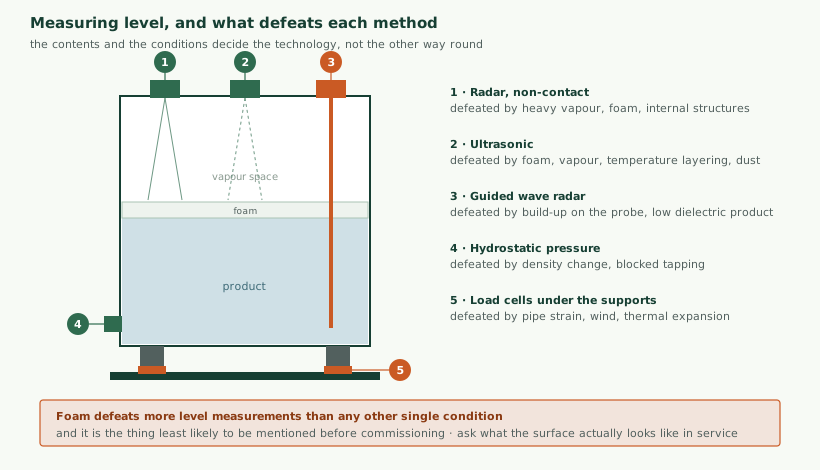
| Method | Suits | Defeated by | Contact |
|---|---|---|---|
| Radar, non-contact | Most liquids, wide temperature and pressure range | Heavy vapour, foam, internal structures, very low dielectric | No |
| Ultrasonic | Clean liquids, open tanks, low cost | Foam, vapour, temperature layering, dust, wind on open water | No |
| Guided wave radar | Difficult products, foam, low dielectric | Build-up on the probe, viscous product, agitation | Yes |
| Hydrostatic pressure | Simple, cheap, well understood | Density change with temperature or product, blocked tapping | Yes |
| Load cells | Mass rather than volume; powders and slurries | Pipe strain, wind, thermal expansion, uneven support | No |
| Capacitance | Small vessels, interfaces | Coating, product property changes | Yes |
| Float or displacer | Simple service, local indication | Mechanical wear, fouling, sticking | Yes |
A few points that recur. Hydrostatic measures head, not level — the reading changes with density, so a tank holding product at varying temperature or holding different products will read differently at the same physical level, which surprises people at commissioning. Load cells measure mass, which is frequently what is actually wanted for stock reconciliation, and their common failure is a rigid pipe connection transmitting force into the vessel and changing the reading whenever a valve operates. And foam is the recurring difficulty: it is invisible on a process diagram, varies with product batch and agitation, and defeats several technologies. Asking what the surface looks like in service — not what the tank contains — is the question that most often prevents a wasted installation.
Where conditions are genuinely difficult, two different technologies can be cheaper than one that repeatedly fails, and disagreement between them is itself informative.
Interfaces, and detecting the wrong thing
Interfaces between two liquids of different density, such as oil above water in a separator, are a distinct problem from level and are frequently specified as though they were the same. A single top-down measurement sees the upper surface and says nothing about where the boundary below it sits, so a tank can be at a constant total level while the interface moves steadily toward a discharge. Guided wave radar, capacitance probes and profiling methods can resolve the boundary; a standard level transmitter cannot. It is worth being explicit at specification about which of the two is actually wanted, because the words are used interchangeably and the instruments are not.
Temperature and cold chain
Temperature monitoring in storage and transport is conceptually simple and consistently harder in practice than expected, mostly because of placement and record-keeping rather than sensing.
Air, product, or something in between
The single most consequential decision is what the sensor is actually measuring. Air temperature in a chiller responds within seconds to a door opening; the product inside responds over hours. An air sensor therefore reports excursions the product never experienced, which generates alarms that get ignored, and ignored alarms are how a real excursion gets missed.
The opposite error also occurs: a unit whose refrigeration is actively cooling the air while product in the middle of a pallet is slowly warming will look correct on an air sensor.
The usual compromise is a sensor embedded in a thermal mass chosen to approximate the product’s response, giving a reading that tracks what the product experiences without requiring a probe in saleable goods. Whatever is chosen, it should be recorded, consistent, and understood by whoever reads the alarms — and mapping studies, which establish where the warm and cold spots in a store actually are, are worth doing before placement is fixed rather than after.
What the record needs to contain
Where cold chain matters commercially or legally, the reading alone is insufficient. What is generally wanted is a defensible account: the measurement with its time, the instrument’s calibration status at that time, the alarm that was raised, who was notified, and what was decided. That last part is frequently missing, and cannot be reconstructed afterwards.
Mean kinetic temperature appears in pharmaceutical contexts as a way of summarising a temperature history into a single equivalent value. It is useful and frequently misapplied: it is a summary for assessing cumulative effect, not a substitute for recording excursions, and a product may have an acceptable mean kinetic temperature while having experienced an excursion that matters on its own.
Various regimes govern temperature-controlled storage and distribution depending on what is stored and where — food safety schemes, pharmaceutical distribution practice, and sector-specific requirements. These shape what has to be recorded, for how long, and who must be able to produce it. We build and document systems; we do not certify, validate or confirm compliance with any of them, and where such a requirement applies we would expect to work alongside whoever owns it.
Water and liquid quality
Water quality monitoring is dominated by one problem: sensors foul, and fouling is the normal condition rather than a fault.
| Measurement | Used for | Maintenance reality |
|---|---|---|
| pH | Process control, discharge consent, treatment | Electrodes drift, need frequent calibration, and have a finite life regardless of care |
| Conductivity | Dissolved solids, leak and ingress detection | Relatively robust; affected by coating and temperature |
| Turbidity | Filtration performance, drinking water | Optical surfaces foul quickly; cleaning is the programme |
| Dissolved oxygen | Aeration control, effluent treatment | Membrane sensors need servicing; optical types less so but still foul |
| Chlorine or disinfectant residual | Disinfection control | Sensitive to flow rate and pH; needs stable sample conditions |
| Flow | Everything else; the denominator for most calculations | Usually stable; installation position matters more than the meter |
| Temperature | Compensation for most of the above | Stable, and required for the others to mean anything |
Three practical points. Most of these measurements are temperature-dependent, so a system without temperature compensation produces readings that vary with the weather. Sample conditioning frequently matters more than the sensor: a sensor in a poorly designed sample line sees something that is not representative of the main flow, and no amount of instrument quality fixes that. And cleaning access must be designed in. A sensor that requires a confined space entry or a process shutdown to clean will not be cleaned at the necessary interval, whatever the procedure says, and the readings will quietly stop being true.
Automatic cleaning systems exist and are worth their cost in dirty service. They are not maintenance-free, and their own failure is silent unless monitored.
Air and gas
Air quality and gas monitoring covers two quite different purposes that are sometimes conflated, with consequences worth stating plainly.
Process and environmental measurement — carbon dioxide for ventilation control, particulates for a cleanroom or an emissions figure, humidity for a storage area, refrigerant leak detection for efficiency — is an ordinary monitoring problem with the usual calibration and placement concerns.
Safety gas detection — flammable gas, oxygen depletion, toxic exposure — is not. It is a life-safety function with its own standards, certification requirements, testing regimes and, generally, its own certified equipment and independent verification. It is not something to assemble from general-purpose sensors alongside a monitoring project, and a monitoring system must never be positioned as providing that protection. Where both are wanted on a site, they should remain separate systems with separate ownership.
For the ordinary measurements, the recurring issues are that many gas sensors have a limited service life and degrade whether used or not, that cross-sensitivity to other gases produces readings that look like the target substance, and that placement must reflect the density and behaviour of what is being detected rather than convenience.
Flow, the denominator for almost everything
Flow deserves separate treatment because so many other figures depend on it. Energy per unit produced, yield, efficiency, consumption against a consent, loss against a mass balance — all of them divide by a flow measurement, so an error there propagates into every derived number without being visible in any of them.
| Method | Suits | Requires | Defeated by |
|---|---|---|---|
| Electromagnetic | Conductive liquids, slurries, dirty water | A full pipe, conductivity above a threshold | Non-conductive fluids, partially filled pipes, coating |
| Coriolis | Mass flow directly, high accuracy, density too | Rigid mounting; a substantial budget | Entrained gas, vibration from nearby plant |
| Ultrasonic, clamp-on | Retrofit without breaking into the pipe | Known pipe material and wall thickness, clean signal path | Pipe lining, corrosion, bubbles, very dirty fluid |
| Ultrasonic, in-line | Clean liquids and gases, low pressure loss | Straight pipe upstream and downstream | Particulates, bubbles, swirl from a nearby bend |
| Vortex | Steam, gases, general liquids | Minimum flow velocity to generate vortices | Low flow rates, pipe vibration |
| Differential pressure | Steam, established practice, wide availability | Impulse lines kept clear; square-root relationship understood | Blocked or frozen tappings, poor turndown |
| Turbine and mechanical | Clean fluids, low cost | Filtration | Wear, particulates, viscosity changes |
| Thermal mass | Gases, particularly compressed air | Known gas composition | Composition change, moisture |
Two points recur across all of them. Installation position matters more than instrument quality. Most flow meters need a length of straight pipe upstream and a shorter length downstream — commonly quoted as something like ten pipe diameters before and five after, though the manufacturer’s figure for the specific meter is what counts. A high-accuracy meter fitted immediately after a bend or a valve measures a disturbed profile and will not deliver its specification. This is the single most common reason a flow measurement disappoints, and it is decided at installation where it costs nothing and is expensive to correct afterwards.
And volumetric flow is not mass flow. A volumetric meter on a gas, or on a liquid whose temperature varies, measures a quantity that changes with conditions. If the figure feeds stock, cost or emissions, compensation for temperature and pressure is needed, or a mass-measuring technology. Systems that quietly confuse the two produce mass balances that never close and nobody can explain.
Humidity, briefly
Humidity matters in storage, in cleanrooms and in any process sensitive to moisture, and it has two characteristics worth knowing. Sensors drift more than temperature sensors do, particularly after exposure to condensation or high concentrations of solvents, so the calibration interval is shorter than people expect. And relative humidity is temperature-dependent by definition: the same air reported at two different temperatures gives two different relative figures, so anywhere temperature varies, absolute measures such as dew point are more meaningful and less likely to be misread.
Instruments you may already have
Before specifying anything, it is worth establishing what is already installed, because process plants commonly hold instruments whose readings go nowhere. A transmitter wired to a controller for a control function may be perfectly good, and its output simply never recorded.
- 4-20 mA loops are the established standard and can usually be read without disturbing the existing function, either by adding a receiver in series or by reading the value from the controller that already has it. Reading it from the controller is preferable where possible, since it introduces nothing into the loop.
- HART is a digital signal superimposed on a 4-20 mA loop, widely supported and frequently unused. Where present it carries far more than the primary value: diagnostics, secondary variables, calibration data and device status. A plant with HART instruments that only reads the analogue value is leaving a good deal unused.
- Existing transmitters with a fieldbus interface may already publish everything needed.
- Instruments feeding a local indicator only are the commonest find: a gauge somebody reads on a round and writes on a clipboard.
The general approach to getting at this is covered in SCADA and PLC integration and retrofitting legacy machines. The reason to look first is straightforward: reading an existing instrument is cheaper than installing a new one, needs no process penetration, and avoids ending up with two instruments that disagree — which, when it happens, consumes more time than either installation.
One caution. An instrument installed for control may not be suitable for the new purpose. A level transmitter adequate for keeping a tank between limits may be nowhere near accurate enough for stock reconciliation, and its calibration history may not exist. Establishing suitability is part of the survey rather than an assumption.
Installation practice
More process measurements are spoiled by installation than by instrument selection. The recurring items:
- Straight pipe runs for flow, as above. Check the requirement before choosing the location, not after.
- Impulse lines on differential pressure must stay clear and, where the fluid can freeze or solidify, be traced and insulated. A blocked impulse line produces a stable, plausible and entirely wrong reading.
- Immersion depth for temperature. A probe inserted too shallowly reads a blend of process and ambient through conduction along the stem, with an error that varies with the weather.
- Thermowells protect the sensor and slow its response, which matters where the measurement drives a fast control action. They also need the right fit: an air gap between sensor and well adds a lag of minutes.
- Sample lines for quality measurement should be short, continuously flowing and taken from a representative point. A long line with low flow measures what happened some time ago to something that has since changed.
- Access. Can it be cleaned, calibrated or replaced without a shutdown or a permit? If not, it will not be done at the stated interval.
- Isolation. Can the instrument be removed while the plant runs? Frequently decided at design and regretted for the life of the installation.
None of this is sophisticated and all of it is cheaper to get right at installation. The general measurement-chain considerations are in sensor selection and signal conditioning, and the interface circuits themselves in sensor interface circuit design.
Two worked situations
A tank farm wanting stock figures
Twelve outdoor tanks holding several products, currently dipped manually twice a day. The business wants automatic stock figures accurate enough for reconciliation and reordering.
The instinct is to fit level transmitters. The considerations that change the specification:
- Stock is mass, not level. Products differ in density, and outdoor tanks vary in temperature through the day and the year. Level alone will not reconcile, so either temperature compensation with known density curves, or mass measurement, is required.
- Which products foam or coat determines the technology per tank, and the answer may differ between tanks. Uniformity is convenient rather than necessary.
- Manual dipping continues during a parallel period. This is how the automatic figures earn trust, and the discrepancies found are informative rather than embarrassing.
- The reconciliation definition needs agreeing first. What counts as stock, how the tank bottom and unpumpable heel are treated, and who owns the figure. Getting this wrong makes the data unusable regardless of instrument accuracy.
The engineering is the smaller part. Defining what the figure means, and validating it against the existing method, is where the work is.
A cold store with alarm fatigue
A store with air-temperature sensors that alarm several times a day, mostly during door openings and defrost cycles. Staff have stopped responding, and a genuine failure went unnoticed for hours.
The sensing is not the problem; the alarms are technically correct. What is wrong is that they report a condition the product never experienced. Changes that address it:
- Move to a product-simulating sensor so the measurement reflects what actually matters.
- Suppress alarms during scheduled defrost, and record the suppression, so it is visible rather than hidden.
- Add a duration condition: an excursion alarms only if sustained beyond the time the product could tolerate.
- Alarm on door open beyond a period, which is the actionable event a person can do something about.
- Alarm on sensor silence, which the previous system did not, and which is what allowed the genuine failure to go unnoticed.
The result is far fewer alarms, each meaning something. Reducing alarm count is not the objective in itself; making every alarm worth responding to is, and it happens to reduce the count.
What it costs, in shape
Figures depend on the site, but the distribution is consistent and differs from machine monitoring in one respect that matters.
| Item | Nature | Notes |
|---|---|---|
| Instruments | One-off | Varies hugely: a pressure transmitter against a Coriolis meter is orders of magnitude |
| Installation and process penetration | One-off | Often exceeds the instrument; shutdown access dominates |
| Infrastructure: power and connectivity | One-off | Dominant at remote sites |
| Data path, storage, alarming | One-off, then small recurring | Retention requirements drive storage more than sample rate |
| Calibration | Recurring, indefinitely | The item most often omitted, and it never stops |
| Cleaning and consumables | Recurring | Electrodes and membranes have finite lives regardless of care |
| Site visits | Recurring | On distributed installations, usually the largest ongoing cost |
The difference from machine monitoring is that three of these recur for the life of the installation. A vibration sensor fitted and working needs very little; a pH electrode needs calibration, cleaning and periodic replacement forever. A business case built on installation cost alone will be wrong by a wide margin over five years, and it is worth modelling the recurring side explicitly before committing — including who does the work, since a plant without the capacity to maintain instruments will find the system degrading regardless of how well it was specified.
Calibration and drift, which is the programme
If one section of this article matters more than the others, it is this one. A monitoring system that is not calibrated does not produce wrong readings in an obvious way; it produces confident readings that stopped being true at an unknown point, which is worse than no reading because decisions get made on it.
| Question | Why it matters |
|---|---|
| What is the reference, and what is its traceability? | A calibration against an uncalibrated reference establishes nothing |
| What interval, and derived from what? | Observed drift, not a default; measure it before assuming it |
| Where does the record live? | A reading without calibration status is uninterpretable later |
| What happens to data found to be out of tolerance? | Decided in advance, or decided under pressure afterwards |
| Who does it, and what does it cost? | The recurring cost people omit from the business case |
| Can it be done without stopping the process? | If not, the interval will slip regardless of intent |
The fourth row is the one most often skipped and the most awkward. If a sensor is found at annual calibration to be reading two degrees high, what is the status of the year of records it produced? There is no universally right answer, but there is a right time to decide: before it happens. A documented position — that data since the last good calibration is treated as suspect, or that a bounded correction is applied and recorded — is defensible. An improvised decision made when a customer is asking is not.
The practical arrangement that works: a reference instrument calibrated externally with a traceable certificate, used to check working instruments in place, with every check recorded whether or not anything was adjusted. Recording checks that found no error is what establishes the drift rate, and the drift rate is what justifies the interval.
Remote and distributed sites
Much of this equipment sits where nobody goes often: pumping stations, tank farms, reservoirs, remote storage, customer premises. The engineering shifts accordingly, and the dominant cost is rarely the hardware.
- Power. Mains is not always available. Battery and solar are common, and both need honest sizing for the worst case rather than the average — a solar installation sized for annual average output fails in midwinter, which is frequently when the site matters most. Battery life covers the calculation.
- Connectivity. Coverage at the specific location, at the specific mounting height, inside the specific enclosure. Not coverage on a map. Choosing IoT connectivity covers the options.
- Physical protection. Weather, flooding, vandalism, theft and livestock are all routine causes of failure at unattended sites.
- Access for maintenance. Every cleaning, calibration or battery change is a visit. Two visits a year to fifty sites is a hundred visits, and that number belongs in the business case from the start.
- Knowing it has failed. A remote instrument that stops reporting must raise an alarm on its silence. Otherwise the absence of alarms reads as good news.
That last point deserves emphasis because it is the characteristic failure of remote monitoring. A system whose sensors have quietly died reports nothing wrong, and unless silence itself is monitored, everyone assumes all is well until somebody visits.
Alarms where the record matters
Alarm design in general — thresholds, fatigue, escalation — is covered in predictive maintenance. Two things differ here.
First, the response is frequently time-bound and consequential. A chiller excursion has a window in which product can be saved; a discharge exceedance may have a notification requirement. That means escalation cannot rely on someone happening to look, and it needs to reach a person with authority at any hour, with a defined path when the first person does not respond.
Second, the alarm and the response both become part of the record. What was raised, who was notified, when they acknowledged it and what was done are as much part of the evidence as the measurement. Building alerting and leaving the record until later is a common sequence and an awkward one, because the missing record cannot be recreated.
Where the data ends up and how it is retained is covered in cloud backends and dashboards, and connecting findings to business systems in OT/IT integration.
Retention, and what the record has to survive
Where monitoring exists to produce evidence, the record has to remain usable for as long as somebody might ask — which can be years after the system that produced it was replaced. That is a longer horizon than most monitoring projects plan for, and it has practical consequences worth settling early.
- How long, and who decided? Retention periods come from contracts, sector requirements or your own policy. Someone has to state the number, because the storage design depends on it and so does the exit plan.
- Can it be read without the original system? A record locked inside a vendor platform is available only while you keep paying and the vendor exists. An export in an open format, taken periodically, is cheap insurance.
- Is the context stored with the reading? A temperature without its location, its units and the identity and calibration status of the instrument is not evidence of anything. This is the commonest defect in retained data, and it cannot be repaired later.
- Can it be altered? Where the record may be challenged, being able to show that data was not edited matters. Append-only storage, or checksums over retained exports, are the usual approaches.
- What happens on migration? Systems get replaced within most retention periods. Whether history moves, and whether it remains interpretable after moving, should be decided while the people who understand it are still available.
The recurring shape of this problem: the reading is easy to keep, the context around it is what makes the reading meaningful, and the context is what gets lost. Storing the calibration record alongside the measurement, rather than in a separate system or a filing cabinet, is the single change that most improves what a retained dataset is worth.
Storage cost is rarely the constraint. Process measurements are small compared with images or vibration waveforms, and years of readings from hundreds of points remain modest. The constraint is almost always organisational: deciding the period, keeping the context, and retaining the ability to read it.
A short glossary
| Term | Meaning |
|---|---|
| Traceability | An unbroken chain of comparisons linking an instrument to a recognised standard. Without it, a calibration establishes only that two instruments agree. |
| Drift | Gradual change in what an instrument reports for an unchanged input. The reason calibration intervals exist. |
| Excursion | A period outside the acceptable range. What most temperature monitoring exists to detect and record. |
| Mean kinetic temperature | A single value summarising a varying temperature history by its cumulative effect. A summary, not a substitute for recording excursions. |
| Mapping study | A survey establishing where the warm and cold spots in a storage space actually are, done before fixing sensor positions. |
| Dielectric constant | A property determining how strongly a material reflects radar. Low-dielectric products are difficult for radar level measurement. |
| Thermowell | A protective pocket allowing a temperature sensor to be removed without opening the process. Adds response lag. |
| Impulse line | Small-bore tubing connecting a pressure instrument to the process. Blockage produces a stable, plausible, wrong reading. |
| Turndown | The ratio between the largest and smallest flow an instrument measures within specification. Poor turndown means low flows read badly. |
| 4-20 mA | The long-established analogue signalling standard. Zero is 4 mA, so a broken wire reading 0 mA is distinguishable from a genuine zero. |
| HART | A digital signal carried on a 4-20 mA loop, giving diagnostics and configuration alongside the analogue value. Widely installed, frequently unused. |
| Dew point | The temperature at which air becomes saturated. An absolute moisture measure, unlike relative humidity, which varies with temperature. |
| Sample conditioning | Bringing a process sample to conditions an analyser can handle. Frequently determines accuracy more than the analyser does. |
| Fouling | Accumulation on a sensor surface that changes what it reads. The normal condition in most water service, not a fault. |
What usually goes wrong
- Choosing the technology before understanding the product. Foam, coating, density variation and agitation each rule out different methods, and none appears on a datasheet.
- Measuring air and reporting it as product. Generates alarms nobody believes, then misses the real one.
- No cleaning access. The sensor will not be cleaned at the required interval, and the readings will drift silently.
- Calibration treated as an afterthought. The recurring cost is omitted from the business case and the interval slips until the data is worthless.
- Alarm without audit trail. The alert exists; the evidence that anyone acted does not.
- No alarm on silence. Dead sensors look identical to good news.
- Underestimating site visits. On distributed installations the visits usually cost more than the equipment.
- Blurring safety and monitoring. Life-safety detection is a separate discipline with separate equipment and must not be implied by a monitoring system.
Deciding what is worth measuring
Because every instrument here carries a recurring cost, the selection question is sharper than in machine monitoring. Three tests separate the measurements worth having from the ones that will be quietly abandoned.
- Is there a decision attached? Not an interest, a decision: reorder, reject, intervene, report. A measurement with no decision behind it will not survive the first calibration it misses.
- Is somebody obliged to look? Regulated and contractual measurements survive because somebody must produce them. Measurements kept out of curiosity are the first to lapse when the person who wanted them moves on.
- Can it be maintained at the required interval? An instrument needing weekly cleaning in a location reachable twice a year will produce plausible readings that are not true. Better to measure less and maintain it than to measure more and trust none of it.
Applying these honestly usually shortens the list, which is the useful outcome. A smaller number of measurements that are calibrated, maintained and acted upon is worth considerably more than a comprehensive installation degrading quietly in the background.
If you take one thing away
Here, unlike almost anywhere else in this field, the measurement is the product. That single difference drives everything: the technology has to survive the specific conditions, the instrument has to be calibrated on a known interval, the record has to carry enough context to be interpretable years later, and all three cost money indefinitely rather than once.
The programmes that fail are rarely the ones that chose the wrong sensor. They are the ones that treated installation as the project and maintenance as a detail.
How we help with this
We work on the engineering: choosing measurements that survive the conditions, designing the installation and sample arrangements, building the data path and storage, setting up alarms and escalation, and documenting what is measured, how it is calibrated and what the records contain.
We would want to understand the product and the conditions before recommending any technology, because for level and water quality in particular the right answer depends on what the material actually does in service. We do not certify, validate or accredit systems, we do not provide life-safety gas detection, and we would not confirm that an installation satisfies a regulation — that belongs with an accredited body or your quality function, alongside whom we would expect to work.
Related reading: asset tracking and remote monitoring for distributed equipment generally, retrofitting legacy machines where a plant already has instruments nothing reads, and what industrial IoT actually is for the wider picture. Services: industrial IoT integration.
Questions we are asked about this
What clients ask before starting
Which level measurement should we use?
It depends on the product and the conditions rather than on any ranking of the technologies. Foam, vapour, agitation, build-up, density variation and internal structures each defeat different methods, and the useful question is what the surface actually looks like in service rather than what the tank contains on paper. Where conditions are genuinely difficult, two different technologies are sometimes cheaper than one that keeps failing.
How often do sensors need calibrating?
It varies by measurement, and the honest answer is that the interval should be set by observed drift rather than assumed. Temperature sensors are relatively stable; pH electrodes may need attention weekly and have a limited life regardless of care. The important thing is to establish drift with a deliberate check programme rather than adopt a manufacturer default and discover the rate later.
Can you provide a validated or compliant system?
We build monitoring systems and document how they work, what they record and how they are calibrated. We do not issue compliance certifications, perform regulatory validation or confirm that a system satisfies a particular regulation — that is for an accredited body or your quality function. Where a regulated requirement applies, we would expect to work alongside whoever owns it rather than substitute for them.
Where should a cold chain sensor go?
Wherever the requirement actually concerns, which is usually the product rather than the air. Air temperature responds quickly and product temperature slowly, so an air sensor produces alarms during a door opening that the product never experienced, and can also miss a slow warming of product in a unit whose air is being actively cooled. A sensor in a thermal mass approximating the product is a common compromise, and the placement should be recorded and consistent.
Do we need a wired system for remote sites?
Rarely, and for a distributed site it is frequently not an option. The constraints shift to power, coverage and physical access. A remote installation that needs a visit every few months to change batteries or clean a sensor is a maintenance commitment, and the cost of those visits usually exceeds the hardware, so it deserves more attention than the sensor specification.
Why did our water quality readings drift?
Most commonly fouling, and it is the normal state rather than a fault. Biological growth, scaling and coating all change what the sensor sees, and rates vary enormously with the water. Sensors in dirty service may need cleaning weekly. A monitoring design that does not include cleaning access and a cleaning schedule tends to produce confident readings that stopped being true some time ago.
Is an alarm enough for a regulated requirement?
Usually not on its own. Where a record matters, what is generally needed is the measurement, evidence that the instrument was calibrated, a record of who was notified and when, and what was done in response — the audit trail rather than the alert. Building the alarm and leaving the record until later is a common and awkward mistake, since the record cannot be reconstructed afterwards.
What do you actually provide?
Measurement selection for the conditions, instrument and installation design, the data path and storage, alarm and escalation logic, and documentation of what is measured, how it is calibrated and what the records contain. We do not certify, validate or accredit anything, and we would not recommend a technology for a difficult tank without understanding what the surface looks like in service.
What are you measuring by hand, or not measuring at all?
Tell us what the material is, where it sits and what the reading is used for. For level and water quality especially, the conditions decide the technology, so that is where a useful answer starts.