
Industrial fieldbus and Ethernet: PROFINET, EtherNet/IP and the rest
The protocols that run machinery, as distinct from the ones that move data. Why the choice was made before you arrived, what is actually installed out there, and how to get data out without touching the control network.
In short
- You do not choose the control protocol. It came with the machine, and changing it is a controls project.
- Read from the controller, publish upward. Joining the control network is rarely necessary and rarely welcome.
- The protocol wars are largely over and settled by vendor ecosystem rather than by merit.
- IO-Link devices frequently hold diagnostics nobody reads, already installed and already paid for.
- Legacy serial buses still run enormous amounts of plant and need a gateway rather than a direct connection.
Two different questions about protocols
There are two protocol conversations in industrial work and they are frequently mixed up, which produces confused projects.
The first is how data gets from a machine to the systems that use it — OPC UA, MQTT, and the choice between them. That is covered in OPC UA, MQTT and Modbus compared, and it is a question you genuinely decide.
The second, which this article addresses, is how a controller talks to the drives, remote I/O and devices that make a machine work. PROFINET, EtherNet/IP, EtherCAT, PROFIBUS and their relatives live here. This is not a choice you make on an integration project. It was made by whoever specified the machine, possibly a decade ago, and it is effectively fixed.
Understanding the distinction matters because it determines where integration work belongs.
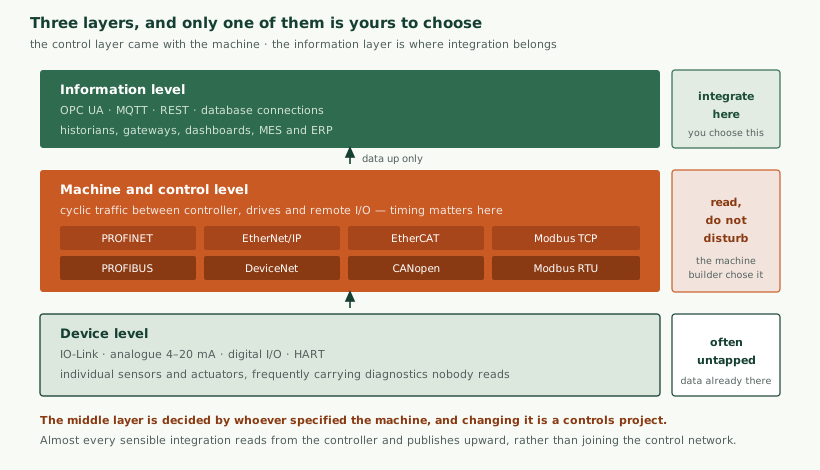
Why there are so many
Newcomers reasonably ask why a dozen protocols exist to do apparently the same job. The history explains the present.
In the 1980s and 1990s, connecting a controller to distributed devices meant proprietary wiring. Several manufacturers developed digital buses to replace it, each becoming a standard associated with its originator’s ecosystem. Interoperability was not the objective; working reliably within one vendor’s product range was.
When Ethernet became cheap and fast enough for industrial use, the same manufacturers adapted it rather than converging. So PROFINET, EtherNet/IP and EtherCAT all run over Ethernet hardware and are not interoperable, because each solves the determinism problem differently and each carries its originator’s device model.
The practical consequence is that protocol choice follows controller choice, which follows machine builder choice, which frequently follows what a plant’s engineers already know. Arguments about which is technically superior are largely beside the point for anyone integrating with equipment that already exists.
The industrial Ethernet protocols
| Protocol | Ecosystem | Approach | Typical use |
|---|---|---|---|
| PROFINET | Siemens and its ecosystem | Standard Ethernet, with real-time channels for cyclic data | Very widespread, particularly in Europe |
| EtherNet/IP | Rockwell and its ecosystem | Standard Ethernet carrying the CIP object model | Very widespread, particularly in North America |
| EtherCAT | Beckhoff and adopters | A frame passing through each node, read and written on the fly | Motion control; very short cycle times |
| Modbus TCP | Vendor neutral | Modbus messages over Ethernet; simple, no determinism | Meters, simple devices, general-purpose reading |
| POWERLINK | B&R and adopters | Scheduled access on top of Ethernet | Motion control, less common |
| Sercos III | Drive manufacturers | Ring topology, hard real-time | Specialised motion applications |
| CC-Link IE | Mitsubishi and its ecosystem | Gigabit industrial Ethernet | Common in Asian markets |
Three things are worth extracting from this. The top three cover most of what you will encounter, and geography is a reasonable predictor of which. Modbus TCP is the odd one out, being vendor-neutral, simple and undemanding — which makes it slow and non-deterministic, and also makes it the most likely thing to be supported by a device outside any ecosystem, such as a meter or a sensor gateway. EtherCAT is architecturally different: rather than addressing nodes individually, a frame passes through each device which reads and writes its portion as it goes, which is why it achieves very short cycle times and why it behaves less like a conventional network.
From a data-extraction point of view, the practical difference between them is smaller than it appears, because you are usually not reading the fieldbus at all. You are reading the controller, which already has the data in its memory, through OPC UA or a driver.
The serial buses that are still everywhere
A large fraction of installed plant still runs on pre-Ethernet buses, and they will keep running for years.
- PROFIBUS DP is the most widespread. An enormous installed base, well understood, and gradually being replaced by PROFINET on new installations. Runs on shielded twisted pair with specific termination requirements — a frequent source of intermittent faults when a segment has been extended casually.
- Modbus RTU is simple, vendor-neutral and ubiquitous on meters, drives and instruments. Its simplicity is why it appears everywhere and why it carries no diagnostics or self-description.
- DeviceNet, built on CAN, appears in the Rockwell ecosystem at device level.
- CANopen is common in machinery, vehicles and medical equipment, particularly where a machine is built from modules.
- AS-Interface is a simple two-wire system for basic sensors and actuators, carrying power and data on the same pair.
For an integration project, these mean two things. Data from them reaches you through the controller or through a gateway rather than over Ethernet directly. And expertise is thinning: engineers fluent in PROFIBUS diagnostics are becoming harder to find, which matters when a segment develops an intermittent fault and nobody on site owns the tooling to trace it.
Determinism, and why the control layer is fussy
The reason these protocols exist, rather than everyone using ordinary Ethernet, is determinism: the requirement that a message arrives within a guaranteed time, every time.
A controller updating a drive’s speed reference needs that update to arrive predictably. Ordinary Ethernet makes no such guarantee — it is fast on average and occasionally delayed, which is fine for a file transfer and not fine for coordinated motion. Each industrial protocol addresses this differently, through reserved time slots, prioritisation, or an architecture that avoids contention altogether.
The relevance to a data project is a negative one: this is why you should not casually add devices to a control network. The timing behaviour is part of what the machine depends on, and traffic that seems harmless can affect it. Beyond the technical risk there is a practical one — a machine builder asked to support equipment after a third party added devices to its control network may reasonably decline.
Reading from the controller instead avoids the entire question. The controller already holds the values; exposing them through OPC UA or a driver connection uses a path designed for that purpose, as covered in SCADA and PLC integration.
Cyclic and acyclic: two kinds of traffic
Understanding this distinction explains a good deal about why integration works the way it does.
Cyclic traffic is the continuous exchange that keeps a machine running: the controller sends outputs and reads inputs every cycle, at a fixed rate, whether or not anything has changed. It is what the determinism requirements exist for, and the cycle time — often a few milliseconds, sometimes far less for motion control — is a design parameter of the machine.
Acyclic traffic is everything else: reading a parameter, writing configuration, fetching diagnostics. It happens on request, it shares whatever capacity is left, and it carries no timing guarantee.
Two consequences follow for anyone extracting data. First, the interesting diagnostics are usually acyclic. Cyclic data is the small set of values the machine needs every cycle; the richer information a device holds is available on request and is frequently never requested. Second, acyclic requests are the polite way in — asking for a parameter does not disturb the cyclic exchange in the way that adding cyclic traffic would.
Device description files
Each protocol family has a file format describing what a device offers: GSD files for PROFIBUS and PROFINET, EDS files for EtherNet/IP and DeviceNet, ESI for EtherCAT, IODD for IO-Link. The engineering software reads these to know what a device is and what it can do.
These are useful during an integration project for a reason that is not obvious: they document what data a device actually exposes, including things the controller program ignores. Where a plant’s documentation is missing, the device description files for the installed equipment are frequently the most complete record of what could be read, and they are generally available from the manufacturer for the asking.
Building a device that has to join one of these networks
Most of this article addresses reading from equipment. The other case is building a product that must sit on an industrial network as a device — a sensor, a drive, an instrument — and the engineering decisions differ.
- Which ecosystems to support is a commercial decision. Each adds a protocol stack, conformance testing and ongoing maintenance. Supporting one well usually beats supporting three poorly.
- Buy the stack rather than write it. Commercial stacks and communication modules exist for every major protocol. Implementing one from the specification is a substantial project with a certification exercise at the end, and it is almost never the right use of a product budget.
- Communication modules are the pragmatic route. A module handling the protocol, connected to your processor over a simple interface, lets one product support several ecosystems by fitting a different module. It costs more per unit and removes most of the development risk.
- Design the device description file carefully. It is how integrators see your product, and a poorly structured one makes a good device awkward to use.
- Expose diagnostics deliberately. The information a device holds about its own condition is increasingly what differentiates it, and it is wasted if the only route to it is a handheld tool.
- Plan for firmware updates over the network. An industrial device with a service life measured in years needs a route to be patched, which the security obligations now make close to mandatory.
The second and third points are where most of the money is saved. A team that decides to implement an industrial Ethernet stack themselves generally underestimates the conformance work by a wide margin, and arrives at certification with a schedule already spent. Buying that capability is unglamorous and is usually the difference between a product that ships and one that does not.
Migrating from a serial bus
Plants running PROFIBUS or DeviceNet eventually face a migration decision, usually prompted by obsolescence or by a machine upgrade rather than by choice.
| Approach | What it involves | Suits |
|---|---|---|
| Leave it alone | Nothing; maintain spares and expertise | Stable plant with a defined remaining life |
| Gateway to Ethernet | A device bridging the old bus to a new network | Getting data out without touching the control system |
| Proxy at the controller | A new controller carrying both interfaces | Staged migration where equipment is replaced gradually |
| Segment-by-segment replacement | Converting one area at a time during shutdowns | Larger sites with planned outage windows |
| Wholesale replacement | New controllers, new network, new devices | A major upgrade justified on other grounds |
For a data project specifically, the second row is nearly always the right answer. A gateway that reads the existing bus and publishes upward gets the data without a controls project, without a shutdown and without any change to a system that is working. Migration of the control network itself is a separate decision on its own timescale, and coupling a monitoring project to it is a reliable way to delay both.
Where migration is happening anyway, it is worth treating as an opportunity: a machine being re-controlled can have an OPC UA server, a documented tag list and a data port specified as part of the work, at marginal cost. That is the cheapest moment such things will ever be available.
A worked situation
A site with equipment from three decades: two older lines on PROFIBUS with controllers from one vendor, a newer line on EtherNet/IP from another, a recently installed machine on PROFINET, and a compressor house with meters speaking Modbus RTU. The business wants production and energy figures across all of it.
The instinct is to worry about the protocol mixture. In practice it matters less than it appears:
- The newer PROFINET machine very likely has an OPC UA server in its controller. Configure it, expose the tags, done — no network change at all.
- The EtherNet/IP line is read through a gateway with the appropriate driver, connecting to the controller. Read-only, no control network changes.
- The PROFIBUS lines are read through their controllers if those controllers have a spare Ethernet interface, or through a gateway otherwise. The fieldbus itself is not touched.
- The Modbus meters are the simplest of all and can be read directly by the same gateway.
- Everything publishes to one place in one naming scheme, which is where the real work is — deciding what an equivalent measurement means across four different vintages of equipment.
The protocol diversity is handled by a gateway with several drivers and is largely a configuration exercise. The genuinely difficult part is what OT/IT integration describes: agreeing what the numbers mean so a figure from the 1990s line is comparable with one from the machine installed last year. That is not a protocol problem, and mistaking it for one is how these projects consume their budget in the wrong place.
A short glossary
| Term | Meaning |
|---|---|
| Fieldbus | A digital network connecting a controller to distributed devices, replacing individual wiring. |
| Cyclic data | The continuous exchange keeping a machine running, at a fixed rate with timing requirements. |
| Acyclic data | On-request reads and writes for parameters and diagnostics. No timing guarantee, and where the interesting information usually lives. |
| Determinism | A guarantee that a message arrives within a bounded time. The reason industrial protocols exist rather than plain Ethernet. |
| Cycle time | How often the controller exchanges data with devices. A machine design parameter, not something to adjust casually. |
| Remote I/O | Input and output modules distributed around a machine rather than in the controller cabinet. |
| GSD, EDS, ESI, IODD | Device description files for PROFIBUS/PROFINET, EtherNet/IP, EtherCAT and IO-Link. They document what a device exposes. |
| CIP | The object model underlying EtherNet/IP and DeviceNet. |
| Termination | Resistors at the ends of a serial bus preventing reflections. Missing termination is the classic intermittent fault. |
| Segment | A section of bus with limits on length and node count, extended with repeaters. |
| Scan time | How long a controller takes per program cycle. Aggressive external polling can affect it. |
| IO-Link master | The module devices connect to, which presents their data to the controller and carries their diagnostics. |
If you take one thing away
The control protocol is not your decision and rarely your problem. It arrived with the machine, it is doing its job, and the data you want is already in the controller’s memory in a form that has nothing to do with which fieldbus delivered it.
So the useful question is never “how do we integrate with PROFINET”. It is “what does this controller already expose, and what is the least intrusive way to read it” — and the answer is frequently an OPC UA server that is already present and has never been switched on.
IO-Link, and the data you may already own
IO-Link deserves particular attention because it represents unread data in plants that already have it.
It is a point-to-point digital link between a sensor or actuator and an input module — not a bus. It replaces a plain analogue or digital signal with a digital exchange, which means the device can report more than one value.
What that enables, and why it matters for monitoring:
- Diagnostics. Signal quality, internal temperature, operating hours, contamination warnings, fault codes. A photoelectric sensor can report that its lens is dirty before it fails to detect.
- Parameters read and written remotely. Setpoints and configuration without a visit with a handheld tool.
- Identification. A replacement device can be recognised and configured automatically, which removes a common source of commissioning error.
- Several process values from one device where a 4-20 mA connection carries one.
The recurring finding is that plants install IO-Link devices for the configuration convenience and never read the diagnostics, because the controller was programmed to take the process value and ignore the rest. Establishing what IO-Link devices exist and what they report is one of the cheapest pieces of discovery available on a modern plant — the data is already being generated by equipment already paid for, and the work is extraction rather than instrumentation.
Wireless at the machine level
Wireless variants of several industrial protocols exist, and there are wireless standards designed for process instrumentation. The honest summary is that wireless has found a real but narrow place at this layer.
Where it works: rotating or moving parts where cable would flex and fail, mobile equipment such as cranes and automated vehicles, temporary installations, and retrofit measurement points where cabling would cost more than the sensor. Process instrumentation standards handle battery-powered transmitters on tanks and pipes well, using mesh arrangements that tolerate obstruction.
Where it does not: fast cyclic control. The determinism requirements that shaped the wired protocols are harder to meet over radio in an environment full of metal, moving machinery and other transmitters, and the consequence of a missed cycle is a stopped machine. Most wireless deployment at this layer is therefore monitoring rather than control, which is precisely the application a data project cares about.
The practical position for a monitoring project is that wireless at the machine level is worth considering for measurement points where cabling is genuinely difficult, and that the general-purpose options covered in choosing IoT connectivity are frequently a better fit than an industrial wireless standard, because they do not require the corresponding infrastructure. The question to settle first is whether the data must reach the controller at all — if it only needs to reach a monitoring system, the control network and its wireless variants are not involved.
Conformance, and what a logo actually means
Each protocol family has an organisation behind it that certifies devices, and the logos appear on datasheets. It is worth knowing what they do and do not tell you.
What conformance testing establishes is that a device implements the protocol correctly enough to interoperate: it responds properly to the defined exchanges, its device description file matches its behaviour, and it does not misbehave on a shared network. That is genuinely valuable, and a device without it is a risk on a network where the machine builder will be blamed for any disruption.
What it does not establish is that the device is suitable for your application, that its measurements are accurate, that it will survive your environment, or that its diagnostics are meaningful. Conformance is about network citizenship, not quality.
For anyone building a device intended to sit on an industrial network, the practical points are that certification takes time and money, that it generally requires membership of the relevant organisation, and that some protocol stacks must be licensed rather than implemented freely. These costs belong in a product budget from the start, and they are a real factor in deciding which protocols a product will support — supporting three ecosystems is three certification exercises, not one. The wider conformity picture is in CE, UKCA and FCC certification, which is a separate matter from protocol conformance and frequently confused with it.
Time-Sensitive Networking, honestly
TSN is a set of extensions to standard Ethernet providing timing guarantees, so deterministic and ordinary traffic can share one network. It appears frequently in industrial marketing and warrants a measured assessment.
What it genuinely offers: the prospect of one physical network carrying control traffic and everything else, with timing guarantees for the traffic that needs them. If realised broadly, that simplifies industrial networks considerably.
What to be cautious about: it requires supporting infrastructure throughout, configuration is not trivial, and it does not by itself make different protocols interoperable — PROFINET over TSN and EtherNet/IP over TSN remain different protocols. Adoption in installed plant is limited, and most equipment you will encounter does not use it.
For a data project the practical answer is that TSN is not something you need. It addresses a control-engineering problem. If you are reading from a controller and publishing upward, nothing in your application depends on the guarantees it provides.
Security on the control network
These protocols were designed when industrial networks were physically isolated, and it shows. Most carry no authentication and no encryption: a device that can reach the network can generally read from it, and frequently write to it.
That is not a criticism of the designs so much as a description of their assumptions. The isolation those assumptions relied on has eroded, and the practical consequences matter for anyone adding connectivity:
- Reaching the control network is close to controlling it. There is usually no second barrier once a device is on the segment, which is why the boundary matters so much more than any device-level measure.
- Diagnostic and engineering access is powerful. The tooling that configures controllers can generally change programs, and it is not always protected by anything more than physical access.
- Newer protocol versions add security features — authenticated and encrypted variants exist — but they require support at both ends and are not present on installed equipment.
- Segmentation is the practical defence, not protocol-level security. The control network should not be reachable from anywhere it does not need to be reachable from.
This reinforces the architectural point made throughout this article from a different direction. Reading from the controller and publishing outward, with the crossing point controlled and the flow one-way, is not only less disruptive — it is also the arrangement that does not extend the reach of anything that could touch the control network. The boundary design is covered in OT/IT integration, and the obligations now attaching to connected equipment in security regulation for connected products.
Working out what you have
A survey question that comes up on nearly every brownfield project. What to look at:
- The controller and its modules. The communication modules fitted usually identify the protocols in use directly.
- Connectors and cable. Distinctive by protocol — PROFIBUS connectors are recognisable, industrial Ethernet uses particular ruggedised styles, AS-Interface uses a flat profiled cable.
- Device labels. Drives, remote I/O and instruments generally state their interface.
- Engineering software. The project file for the controller lists the network configuration, and is the definitive answer where it is available.
- The machine builder or commissioning contractor. Usually the fastest route where documentation is missing.
Worth establishing at the same time: whether an OPC UA server already exists in the controller, since many modern controllers include one and it is regularly unused; whether spare capacity exists for a communication module; and who supports the machine, because their view on what may be connected matters. The wider survey approach is in retrofitting legacy machines.
Getting data out
| Route | Requires | Intrusiveness |
|---|---|---|
| OPC UA server in the controller | A capable controller; configuration | Very low; designed for this |
| Read from SCADA or historian | The data already collected there | Very low; nothing touches the machine |
| Driver connection to the controller | A gateway with the right driver; a route to the controller | Low; read-only, no control network changes |
| Additional communication module | A slot, and a controls change | Moderate; a controls project, however small |
| Gateway on the fieldbus | Adding a node to the control network | Higher; affects the network the machine depends on |
| Separate external sensors | Nothing from the machine at all | None to the machine; a parallel measurement |
The last row is worth remembering because it is frequently forgotten. Where a machine is old, unsupported, or where its owner will not permit any connection, measuring externally — current, vibration, cycle timing — avoids the question entirely. It gives less information than reading the controller and it requires nobody’s permission, which sometimes makes it the only route that will actually happen. That approach is covered in retrofitting legacy machines and condition monitoring.
Cabling, connectors and the physical layer
A disproportionate share of industrial network faults are physical, and they present as software problems — intermittent dropouts, devices that vanish and return, errors that correlate with production rather than with anything in the logic.
| Issue | Typical symptom | Where it comes from |
|---|---|---|
| Missing or incorrect termination | Intermittent errors on a serial bus, worse with length | A segment extended without adding termination |
| Segment length exceeded | Errors rising with traffic; works at low load | Rules ignored during an extension |
| Too many nodes on a segment | Gradual degradation as devices are added | Each bus type has a limit; repeaters exist for a reason |
| Wrong cable type | Works on the bench, fails in the plant | Office patch cable used for industrial Ethernet |
| Shield connected at both ends | Noise correlated with heavy equipment starting | The shield carries current between two grounds |
| Cable run alongside power | Errors when a drive or contactor operates | Separation rules not observed during installation |
| Connector ingress or vibration | Faults on one machine, moving with the cable | Wrong connector rating for the environment |
| Mixed speed or duplex settings | Poor throughput, collisions, retries | A manually configured port meeting an auto-negotiating one |
Two of these are worth expanding. Termination on serial buses is the single most common cause of intermittent PROFIBUS and Modbus RTU faults. The rules are specific and unforgiving, a network with incorrect termination frequently works well enough to pass commissioning, and the failures appear later under load or temperature. When an established network starts misbehaving after somebody added a device, this is the first thing to check.
And office cable in an industrial environment is a recurring find. Industrial Ethernet cable exists because plant floors have oil, flexing, vibration, temperature and electrical noise. Standard patch cable works initially and degrades, which produces a fault that appears months after the installation everyone has stopped thinking about.
The wider treatment of interference, shielding and return paths is in EMC and compliance design; the principles are the same whether the victim is a product under test or a plant network.
Diagnosing a network problem
An order of investigation that resolves most cases:
- Read the controller’s own diagnostics first. Most controllers count errors, retries and lost frames per device. This usually localises the problem before any instrument is connected.
- Look for a pattern in time. Faults correlating with a shift, a machine starting or an ambient temperature point at a physical or electrical cause rather than a configuration one.
- Look for a pattern in space. Errors concentrated at the far end of a segment suggest length, termination or attenuation.
- Check what changed. A network stable for years that has started failing usually had something added, moved or replaced, and the person who did it may not connect the two events.
- Then reach for instruments. Bus analysers for serial networks, managed switch statistics for Ethernet. Powerful, and rarely needed before the four steps above.
Two habits pay for themselves repeatedly: recording error counters regularly rather than only when something is wrong, so that a gradual rise is visible, and keeping a network diagram that is updated when anything changes. Both are unglamorous, and their absence is why a fault that should take an hour takes a week.
Safety networks, which are separate
Most of these protocol families have a safety variant — safety layered over PROFINET, EtherNet/IP or EtherCAT — carrying emergency stops, light curtains, guard interlocks and similar functions.
These are a distinct discipline with their own certification, their own design rules and their own competence requirements. They frequently share physical cabling with standard traffic, which occasionally leads people to treat them as ordinary network traffic. They are not.
For a data project the position is simple and firm: safety functions are read-only at most, and generally not touched at all. Reading a safety system’s status for reporting can be legitimate; anything that could affect its operation is a matter for whoever holds responsibility for the machine’s safety assessment. We do not take on safety function work, and where a project appears to require it, that needs a specialist engaged separately. The same boundary is stated in process and environmental monitoring about gas detection and in edge gateways about local logic.
Specifying a new machine
Occasionally you do get to influence the protocol — when procuring new equipment. Points worth including in a specification, which cost nothing at purchase and are expensive to retrofit:
- Require an OPC UA server on the controller, with an agreed set of exposed tags. Many controllers support it and it is not configured unless asked for.
- Require the tag list as documentation, with units, scaling and meaning. This is the register map argument from edge gateways, applied at purchase where it is free.
- Specify a separate network port for data, so monitoring traffic need not share the control network.
- Ask what diagnostics devices provide and require that they be exposed rather than consumed internally — the IO-Link point above.
- Agree what connection is permitted without affecting support or warranty. Settling this at purchase avoids a difficult conversation later.
- Prefer consistency with your estate where it does not compromise the machine. A site with one controller family needs one set of skills and spares.
The first two are the highest value. A machine arriving with an OPC UA server already exposing a documented tag list turns a future data project from an integration exercise into a configuration one, and machine builders will generally provide it if it is in the specification — and generally will not if it is not.
What usually goes wrong
- Adding a device to the control network because it was possible. Technical risk, and a support conversation with the machine builder.
- Assuming protocol support means your device is supported. Serial protocols in particular have vendor-specific variations.
- Ignoring an existing OPC UA server. Many modern controllers have one, unconfigured.
- Not reading IO-Link diagnostics. Data already being generated, already paid for, discarded.
- Polling the controller aggressively. Affects scan time, which makes a monitoring project unwelcome quickly.
- Treating a PROFIBUS segment casually. Termination and segment rules exist for a reason; casual extension produces intermittent faults.
- Specifying by protocol rather than by outcome. “We need EtherNet/IP” is usually a conclusion somebody reached, not a requirement.
How we help with this
We identify what is installed, design the data path from the controller upward, do the gateway and protocol work, and arrange the boundary so the control network is not disturbed.
We would survey before proposing anything, because what is possible depends on the controllers and networks in place and cannot be established from a distance. We do not reprogram machine control logic or modify safety functions — where a change to the controller program is genuinely needed, that belongs with whoever supports the machine, and we would work alongside them.
Related reading: OPC UA, MQTT and Modbus compared for the layer above, SCADA and PLC integration for reading from controllers, industrial edge gateways for the hardware in between, OT/IT integration for where the data goes, and retrofitting legacy machines where there is nothing to read. Services: industrial IoT integration. For the wider picture, what industrial IoT actually is.
Questions we are asked about this
What clients ask before starting
Can we just put a device on the PROFINET network to read data?
Technically possible and usually a poor idea. The control network carries cyclic traffic with timing requirements, and adding a device to it means adding something to a network whose behaviour the machine depends on. It may also affect warranty or support arrangements with the machine builder. Reading from the controller and publishing upward achieves the same result without touching the control network, which is why nearly every sensible integration works that way.
Which industrial Ethernet protocol is best?
The question rarely arises in practice, because the answer came with the machine. PROFINET, EtherNet/IP and EtherCAT are each dominant within a particular vendor ecosystem, all are mature, and the differences that matter to a controls engineer specifying a new machine are mostly irrelevant to someone extracting data from an existing one. If you are specifying new equipment, the more useful criterion is what your team already knows and what your existing estate uses.
Is PROFIBUS obsolete?
Not in the sense of being unsupported — there is an enormous installed base still running, and it will be running for years. It is legacy in the sense that new installations generally use PROFINET. For an integration project the practical implication is that a PROFIBUS network needs a gateway or a controller connection rather than a direct Ethernet link, and that expertise in it is becoming harder to find.
What is IO-Link and why does it keep coming up?
A point-to-point digital link between a sensor and an input module, replacing a plain analogue or digital signal. It matters for data projects because IO-Link devices commonly report diagnostics — signal quality, internal temperature, operating hours, fault codes — that a 4-20 mA connection cannot carry. Plants that have installed IO-Link sensors frequently have useful data sitting unread in devices they already own.
Do we need Time-Sensitive Networking?
Almost certainly not for a data project. TSN addresses deterministic traffic sharing a network with ordinary traffic, which is a control-engineering concern rather than a monitoring one. If you are reading data from a controller and publishing it upward, the timing guarantees TSN provides are not something your application needs.
How do we find out what protocol a machine uses?
Look at the controller and its communication modules, the cable and connector types, and the machine documentation. Connector styles are frequently distinctive. Where documentation is missing, the machine builder or the controls contractor who commissioned it is usually the fastest route, and establishing this is part of a survey rather than something to guess at from a distance.
Can one gateway handle several protocols at once?
Many can, and it is a common requirement on a mixed site. The practical caution is that supporting a protocol and supporting it well are different things: check that the specific device and data you need are covered, not just that the protocol name appears on a datasheet. Serial protocols in particular have vendor-specific variations that generic support may not cover.
What do you actually provide?
Identifying what is installed, designing the data path from the controller upward, gateway and protocol work, and the boundary arrangements that keep the control network undisturbed. We would survey before proposing anything, because what is possible depends entirely on the controllers and networks already in place. We do not reprogram machine control logic or alter safety functions.
What do your machines actually speak?
Tell us what controllers you have and what the machines are. If you are not sure what protocol is in use, that is a normal starting point and part of what a survey establishes.