
CE, UKCA and FCC: getting an electronic product certified
Nobody issues you a CE mark. How self-declaration works, why a pre-certified radio module does not make your product compliant, what the technical file must contain, and why pre-compliance testing pays for itself.
In short
- Nobody issues you a CE mark. For most electronics you assess your own product and sign a declaration. The liability is yours.
- A certified radio module does not make your product compliant. The finished product is what gets assessed.
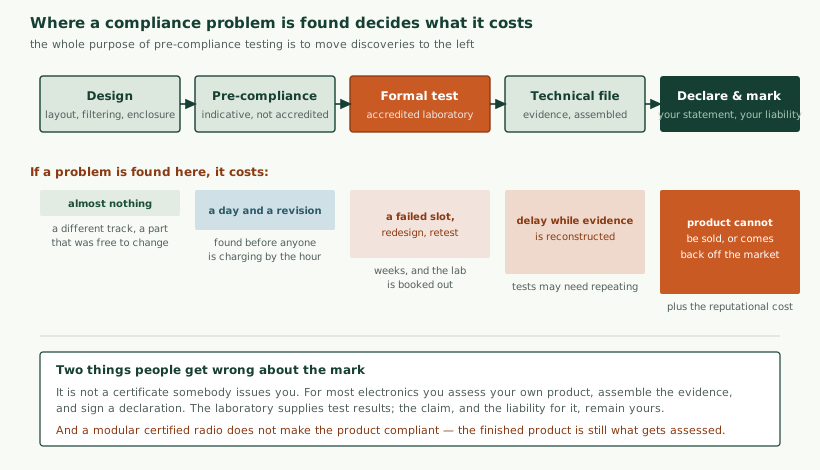
- Pre-compliance testing exists to move discoveries earlier, where a fix is a board revision rather than a failed booking and a redesign.
- The technical file is the deliverable, not the test report. Assembling it retrospectively is where projects stall.
- Book the laboratory early. Lead times, not testing, dominate the timeline.
What the mark actually means
There is a persistent belief that certification means sending a product somewhere and receiving a certificate. For most electronic products that is not how it works, and the misunderstanding causes real problems because it puts the responsibility in the wrong place.
For the majority of electronics, conformity is self-declared. You establish which rules apply to your product, satisfy yourself that it meets them, assemble evidence in a technical file, sign a declaration of conformity and apply the mark. A test laboratory measures and reports; it does not certify the product. For certain higher-risk categories a notified body must be involved, but general electronics is usually not among them.
Two consequences follow. First, the liability sits with whoever places the product on the market — you, or your customer if they rebrand it. A test report does not transfer that. Second, the technical file is the actual deliverable. If a market surveillance authority asks, what they want to see is the file, and a product with good test results and no assembled file is in a worse position than people expect.
This article describes how the process generally works, to help plan a project. It is not legal advice and it is not a statement of what applies to any particular product. Which rules apply depends on the product, its function, where it is sold and how it is classified, and the position changes. We prepare products and evidence; we do not certify, we are not a notified body or an accredited laboratory, and we do not confirm that a product is compliant.
Working out what applies
The first task is establishing which rules your product falls under, and it is less obvious than it sounds because several usually apply at once and they overlap.
| Area | Covers | Typically triggered by |
|---|---|---|
| Electromagnetic compatibility | Emissions from the product, and its immunity to interference | Almost any electronic product |
| Radio | Radio parameters, spectrum use, and efficient use of spectrum; absorbs EMC and safety for radio products | Any intentional radiator: Wi-Fi, cellular, Bluetooth, LoRa |
| Electrical safety | Protection against electric shock, fire, mechanical hazards | Mains-powered equipment, and above certain voltages |
| Restricted substances | Limits on lead, cadmium and others in the materials | Nearly all electronics |
| Chemicals registration | Substances of concern in the product | Materials and components used |
| Waste electricals | Producer responsibility, marking, take-back | Placing electronics on the market |
| Packaging and batteries | Separate regimes with their own marking and reporting | Anything shipped with a battery |
| Machinery | Where the product is part of, or controls, machinery | Industrial equipment, drives, safety functions |
| Product security | Requirements for connected products, phasing in across jurisdictions | Anything networked |
Two observations. Radio equipment rules generally absorb the EMC and safety requirements rather than sitting alongside them, so a radio product is assessed under one framework covering all three. And the ones that catch people out are rarely the technical directives — it is the producer-responsibility regimes for waste, batteries and packaging, which are administrative, vary by country, and are frequently discovered after the product is already selling.
For the United States the shape differs: radio and unintentional radiators fall under the FCC rules, with an equipment authorisation procedure that for most products means testing at a recognised laboratory and, for intentional radiators, a certification process involving a telecommunication certification body. It is closer to the “somebody issues something” model than the European approach, which is one reason the two are frequently confused.
Standards and the presumption of conformity
Rules state requirements in general terms. Harmonised standards translate them into specific tests and limits, and demonstrating conformity to the relevant standards gives a presumption that the requirement is met. You are not strictly obliged to use them, but demonstrating conformity another way is considerably harder, so in practice the standards define the work.
Identifying the right standards for a product is a real task and getting it wrong is expensive: testing against a standard that does not apply produces a file that does not support the declaration. Standards are also revised, and a version cited in an old report may no longer be current, which is a routine finding when an existing product is reviewed after some years.
Pre-compliance, and why it pays for itself
Formal testing happens at an accredited laboratory in a controlled environment, and it is expensive, booked in advance and slow to repeat. Pre-compliance testing is the same measurements taken less formally — a smaller chamber, a bench setup, a consultant with portable equipment — producing indicative results that cannot be used as evidence.
The value is entirely in timing. A radiated emissions problem found during design is a track routed differently, a ferrite added or a component changed, costing effectively nothing. The same problem found at formal test costs the failed booking, a redesign, new boards, and a second booking into a laboratory that may be weeks out. The measurement is identical; only the consequences differ.
| Stage | Worth measuring | Typically finds |
|---|---|---|
| Schematic and layout review | Nothing yet — review against known practice | Missing filtering, poor return paths, unprotected interfaces |
| First prototype | Radiated emissions, conducted emissions | Clock harmonics, switching supply noise, cable radiation |
| Prototype with enclosure and cables | Repeat emissions; add immunity spot checks | Problems the bare board never showed |
| Pre-production | Full pre-compliance sweep | Margin: how close to the limit, which decides whether to risk formal test |
| Formal | Everything, accredited | Ideally nothing new |
The third row matters more than it appears. A bare board on a bench frequently passes; the same board in its enclosure with real cables attached frequently does not, because cables radiate and an enclosure changes coupling. Testing a representative configuration — the actual cables, the actual enclosure, the actual power supply — is what makes pre-compliance predictive rather than reassuring.
Margin is the other thing to watch. A product that passes by a fraction of a decibel will fail on another day, in another chamber, or on a later production batch with slightly different components. Design practice that creates margin is covered in EMC and compliance design, and the layout decisions behind it in PCB design in practice.
Immunity, which is half the EMC requirement and gets a quarter of the attention
EMC has two halves: what the product emits, and what it tolerates. Emissions get the attention because they are what people picture, and immunity failures are frequently the more disruptive because they are harder to diagnose and can appear only intermittently in service.
| Test | Simulates | Typical failure | Usual cause |
|---|---|---|---|
| Electrostatic discharge | A person touching the product | Reset, lockup, corrupted display, damage | Exposed connectors, buttons, no discharge path |
| Electrical fast transient | Switching of inductive loads nearby | Communications errors, resets | Poor filtering on power and signal lines |
| Surge | Lightning, heavy switching on the supply | Damage to the supply or interfaces | Missing or undersized protection devices |
| Radiated immunity | A nearby transmitter, a radio handset | Analogue readings shift, sensors misread | Long unshielded cables, high-impedance inputs |
| Conducted immunity | Interference arriving on cables | Similar to radiated, at lower frequencies | Cable entry without filtering |
| Dips and interruptions | Supply sags and brief outages | Resets, corrupted storage, failure to restart | Insufficient hold-up, unsafe write handling |
| Magnetic field | Proximity to transformers and heavy current | Display distortion, sensor error | Susceptible components sited near the field |
Two things about immunity are worth understanding before a test week. First, the standard defines acceptable behaviour, and it is not always “nothing happens”. Performance criteria generally distinguish between functioning normally throughout, temporary degradation that self-recovers, degradation needing operator intervention, and damage. Which criterion applies depends on the test and the product, so a product that resets and recovers may pass one test and fail another. Knowing which behaviour is acceptable before testing prevents both unnecessary redesign and unpleasant surprises.
Second, the dips and interruptions test finds firmware problems, not just hardware ones. A product interrupted mid-write to non-volatile storage can corrupt configuration in a way that does not appear until much later. This is one of the few places where a certification test exercises something a normal functional test never does, and it is worth treating the result as genuinely informative about the product rather than as a hurdle. The firmware side of this is covered in embedded firmware practice.
Common emissions failures, and what usually fixes them
Most emissions failures fall into a small number of categories, and recognising the pattern from the frequency shortens diagnosis considerably.
- Narrow peaks at multiples of a clock. A clock or its harmonics escaping, usually via a cable or a long track. Fixes: slew-rate control, series termination, better return path, sometimes spread-spectrum clocking where the application tolerates it.
- Broad elevation in the low hundreds of megahertz. Frequently a switching supply. Fixes: input and output filtering, attention to the switching loop area, shielding the inductor.
- Emissions that change when a cable is moved. The cable is the antenna and something is driving it common-mode. Fixes: common-mode chokes, filtering at the connector, correcting the ground arrangement.
- Emissions that appear only in one operating mode. Something enabled in that mode is the source, which at least makes it easy to localise.
- A failure that appears on production units but not prototypes. A component change, a different batch, or an assembly difference. This is the most awkward category and the argument for margin.
The general design practice that prevents these is in EMC and compliance design; the point here is that a failure at test is usually diagnosable within the chamber if somebody who understands the design is present with a few components.
What happens when the product changes
Certification describes a product at a point in time. Products change: components go obsolete, suppliers substitute, firmware is updated, enclosures are revised. Deciding which changes require action is a recurring question with real cost attached either way.
| Change | Usual implication |
|---|---|
| Firmware change affecting radio behaviour | Reassessment of radio parameters likely |
| Firmware change elsewhere | Generally no retest; file updated. Security requirements may apply separately. |
| Passive component substitution, like for like | Usually no retest; record the equivalence rationale |
| Change to a filter, protection or shielding part | Retest emissions and immunity. These parts are why it passed. |
| Switching regulator or clock source change | Retest emissions. High likelihood of a different result. |
| Antenna change | Radio reassessment almost certainly |
| Enclosure material or aperture change | Retest emissions; shielding behaviour changes |
| Cable length or type change | Retest; cables dominate radiated emissions |
| New manufacturing site | No retest as such, but verify the build is equivalent |
The practical arrangement is a documented change-control process that records, for every change, whether it was assessed as affecting compliance and why. That record is part of the technical file and it is what allows a defensible answer years later. A product whose bill of materials has drifted through a dozen undocumented substitutions has a file describing something that is no longer made.
Component obsolescence makes this unavoidable rather than optional over a product’s life, and the cost of requalification is a real input to cost-reduction decisions — a saving that triggers a full retest has to be large to be worth it. That trade-off is covered in product cost reduction.
Batteries, and getting the product shipped
A requirement that surprises people because it is not a market-access rule at all: lithium cells and batteries, and products containing them, are classed as dangerous goods for transport and generally require testing to the United Nations transport criteria before they can be shipped by air or sea. The testing is done on the cell and battery rather than on your product, so a battery bought from a reputable supplier normally comes with the evidence — but it must be obtained and held, and an unbranded cell from an unknown source frequently cannot supply it.
This catches out prototype shipments as much as production. A courier asked to carry a product with an unfamiliar battery and no documentation may simply refuse, and discovering that two days before a customer demonstration is a memorable way to learn it. The related design considerations are in battery life for IoT devices.
Selling into more than one market
Most products are eventually sold somewhere beyond the first market, and the work involved varies from trivial to substantial depending on what is added.
| Consideration | Effect |
|---|---|
| Radio bands and power limits | Differ by region. A product may need per-region configuration or separate variants. |
| Mains voltage and plug type | Affects the supply design and safety assessment |
| Test report acceptance | Some regions accept reports from recognised laboratories; others require local testing |
| Local representative | Several regions require a responsible party established locally |
| Language requirements | Instructions and safety information, sometimes in several languages |
| Producer responsibility | Waste, batteries and packaging registration, generally per country |
| Marking | Different marks, sometimes with placement and size requirements |
The item that most often causes delay is not technical. Producer-responsibility registration and local-representative requirements are administrative, have lead times, and are typically discovered when a distributor asks for evidence shortly before a launch. Establishing the full list of target markets early, even provisionally, lets the administrative work run in parallel with the engineering instead of after it.
On the radio side, designing for the widest intended set of regions from the start is usually cheaper than adapting later, because it influences antenna selection, transmit power provision and whether region configuration is possible at all. A product hard-coded for one region can be difficult to sell elsewhere without a hardware change.
What it costs, and how long it takes
Figures vary enormously with product complexity, the number of radios and the markets involved, so what follows is shape rather than quotation.
| Item | Nature | Notes |
|---|---|---|
| Design effort for compliance | Absorbed into development | Cheapest possible place to spend it |
| Pre-compliance testing | Modest, repeatable | Pays for itself on the first problem found |
| Formal testing | Substantial, per standard and per configuration | Multiplies with radios and variants |
| Laboratory lead time | Weeks | Usually the schedule constraint, not the testing |
| Technical file preparation | Moderate, and underestimated | Supplier declarations are the slow part |
| A failure and retest | Redesign, new boards, second booking | The contingency the schedule needs |
| Additional markets | Varies from small to another full cycle | Depends on report acceptance and radio differences |
| Ongoing maintenance | Small, recurring | Change assessment, file updates, standards revisions |
Two planning points follow. Assume one failure. Not because the design is poor but because the cost of the assumption is a contingency slot and the cost of not making it is a missed launch. And book the laboratory before the design is finished, working backwards from the launch date, because the booking is the least flexible element in the whole sequence.
The sequence that tends to work: design with the requirements in mind, pre-compliance as soon as a prototype exists, fix what is found, pre-compliance again on something representative of production, book formal testing with contingency, assemble the file in parallel rather than afterwards, and test formally when the margin looks comfortable rather than when the date arrives.
Radio modules, and the modular approval trap
Using a pre-certified radio module is sensible and genuinely reduces work. It also produces the most common misunderstanding in this field.
Modular approval means the module was assessed in a specific configuration: a defined antenna, a defined ground arrangement, defined supply conditions. Your product differs in most of those. What the approval typically carries over is the radio parameters themselves — transmit power, occupied bandwidth, spurious emissions from the radio — provided you use the module within its stated conditions and, critically, with an antenna of the type and gain it was approved with.
What it does not carry over is the rest of the product. Your processor, switching supply, display and cables all emit, and the finished product is still assessed for emissions and immunity. Integrators regularly discover this late.
- Read the module’s integration conditions. They specify antenna types, keep-out areas, ground plane requirements and labelling obligations. Departing from them can void the approval.
- Antenna substitution is not free. Fitting a different antenna, even an apparently similar one, generally requires reassessment of the radio parameters.
- Labelling obligations transfer to you. Module identifiers frequently have to appear on the product or its packaging.
- Your own emissions remain yours. A quiet module does not help a noisy product.
The technical file
The file is what you must be able to produce, and it needs to exist before the declaration is signed rather than being assembled if somebody asks. Contents vary by product and applicable rules, but the shape is consistent:
- A description of the product, its function and its variants.
- Design documentation: schematics, layout, bill of materials, enclosure drawings.
- The list of rules and standards applied, with versions.
- Test reports supporting each claim.
- A risk assessment where required.
- Declarations for critical components and materials, including restricted-substances evidence from suppliers.
- User documentation: instructions, warnings, markings.
- The signed declaration of conformity itself.
Two practical points. Supplier declarations for restricted substances are the usual bottleneck — collecting them across a bill of materials takes longer than anyone allows, and small or distant suppliers may be slow or unable to provide them. Starting that collection at design rather than at the end saves weeks.
And the file must match the product being sold. A file describing a prototype that differs from production, or an earlier revision, does not support the declaration. Keeping the file current as the product changes is an ongoing obligation, not a one-off task.
Working with a test laboratory
A few things make the difference between a smooth test week and an expensive one.
- Book early. Lead times of several weeks are normal and worse at busy periods. The booking usually determines the launch date, not the engineering.
- Agree the test plan in advance. Which standards, which configurations, what constitutes normal operation. Disagreement on the day costs chamber time.
- Bring the product working, in its final form. With enclosure, real cables, real power supply and a way to exercise it in its normal mode.
- Bring a way to make changes. Ferrites, capacitors, copper tape, a soldering iron. Many failures can be diagnosed and provisionally fixed in the chamber, which turns a failed test into a known fix.
- Bring someone who understands the design. A laboratory can tell you a product failed at a frequency; only your engineer knows what runs at that frequency.
- Ask what they need beforehand. Support equipment, software to cycle modes, spare units. Turning up short of something wastes a booked slot.
It is also worth understanding what the laboratory is and is not responsible for. They measure against a standard and report. They are generally not responsible for deciding which standards apply to your product, and a laboratory that tests what you asked for is not at fault if you asked for the wrong thing.
ATEX and intrinsic safety
Equipment for potentially explosive atmospheres — dust, vapour, gas — is a different discipline, and we would advise treating it as such from the first design meeting.
The requirements shape the electronics from the beginning: energy limitation, component derating, separation distances, enclosure construction, and constraints on what can be connected. These cannot be retrofitted to a design that was not built for them, and certification generally involves mandatory third-party assessment rather than self-declaration.
This is not work we take on, and we would say so at the first conversation rather than discovering it midway. Where a project has an explosive-atmosphere requirement, engaging a specialist before the architecture is fixed is what avoids an expensive restart.
IP ratings, and what they do not tell you
Ingress protection ratings are widely quoted and widely over-interpreted. The rating describes performance in a defined laboratory test: the first digit for solid objects and dust, the second for water.
| Tested | Not tested |
|---|---|
| Dust ingress under defined conditions | Abrasive or conductive dust over time |
| Water from defined directions and pressures | Pressure washing beyond the tested level, steam |
| Immersion to a stated depth and duration | Repeated immersion, or prolonged submersion |
| The enclosure as presented | Ageing of seals, gaskets, and cable glands |
| — | Chemicals, cleaning agents, solvents, salt, UV |
| — | Condensation, which forms inside regardless of rating |
Condensation deserves particular mention because it defeats the intuition behind the rating. A sealed enclosure that heats and cools will move air, and moisture arrives with it. An enclosure rated against external water can accumulate internal moisture over months, and the usual answers are a breather vent designed for the purpose, conformal coating, or accepting the ingress and designing the electronics to tolerate it.
The practical position: an IP rating is a useful shorthand and a poor specification. What matters is what the product will actually be exposed to, and that belongs in a conversation about the environment rather than a number on a datasheet.
Electrical safety, where the constraints are physical
Safety assessment applies to mains-powered equipment and above certain voltages, and it differs from EMC in an important way: the requirements are largely dimensional and material, so they constrain the physical design from the first layout rather than being adjustable later.
- Creepage and clearance. Minimum distances across a surface and through air between conductors at different potentials. They depend on voltage, pollution degree and material group, and they dictate board layout around anything mains-connected. Discovering the requirement after the board is laid out generally means a new board.
- Insulation classification. Functional, basic, supplementary, reinforced and double insulation each mean something specific and carry different distance and construction requirements. Which applies depends on what the insulation is protecting against.
- Protective earthing. Where used, it needs adequate conductor sizing, a reliable connection, and continuity that survives handling. It is tested.
- Component approvals. Safety-critical components — mains transformers, optocouplers crossing an insulation barrier, fuses, Y-capacitors, mains connectors — generally need their own approvals, and the file needs evidence for each.
- Enclosure and access. Whether a user or a service engineer can reach hazardous parts, and what tools are required, determines what protection is needed.
- Temperature rise. Measured under fault and normal conditions; materials have rated limits and exceeding them is a failure regardless of whether anything stops working.
The practical consequence is that safety requirements have to be established before layout rather than after. An isolated design where the creepage distance was not planned is not adjustable by adding a component; the barrier either has the distance or it does not.
A common and sensible simplification for lower-volume products is to avoid mains inside the product entirely by using an externally certified power supply. That moves a substantial part of the safety assessment onto a component somebody else has approved, and for many industrial and connected products it is the pragmatic choice. It does not remove the need to assess the product, but it removes the hardest part of it.
A worked sequence
To make the timeline concrete, consider a connected industrial sensor: an externally powered device with a cellular radio, a handful of analogue inputs and a sealed enclosure, intended for European and UK sale initially with North America later.
- Before schematic. Establish which rules apply. Radio equipment requirements will absorb EMC and safety. Restricted substances and waste obligations apply. Decide now that North America is a later target, because it influences the radio module and antenna choice rather than being free to add afterwards.
- During design. Choose a radio module with approvals covering the intended regions. Follow its integration conditions exactly. Design filtering and protection on every interface leaving the enclosure. Use an externally approved power supply. Start collecting supplier substance declarations now, because this takes longer than anything else on the list.
- First prototype. Pre-compliance radiated and conducted emissions, with the real enclosure and real cables. Expect to find something. Fix it while a board revision is routine.
- Second prototype. Repeat emissions, add electrostatic discharge and fast-transient spot checks. Test the firmware’s behaviour through supply interruptions deliberately.
- Pre-production. Full pre-compliance sweep. Assess margin. Book formal testing with a contingency slot, working back from the launch date.
- In parallel. Assemble the technical file. Chase the outstanding supplier declarations, of which there will be some.
- Formal test. Attend with an engineer and a box of components.
- After. Sign the declaration, apply the marks, register for producer-responsibility obligations in each country of sale, and put a change-control process in place so the file stays current.
The engineering content of that sequence is modest. What makes it work is that the slow items — laboratory booking, supplier declarations, administrative registration — were started early enough to run alongside the design rather than queue behind it.
A short glossary
| Term | Meaning |
|---|---|
| Declaration of conformity | The signed statement that a product meets the applicable requirements. The legal instrument; the mark is just its visible sign. |
| Technical file | The assembled evidence supporting the declaration. What an authority asks to see. |
| Harmonised standard | A standard whose application gives a presumption that a requirement is met. Not mandatory, but the practical route. |
| Notified body | An organisation designated to carry out conformity assessment where third-party involvement is required. Not needed for most general electronics. |
| Accredited laboratory | A test house whose competence is formally recognised, so its reports carry weight as evidence. |
| Pre-compliance | Indicative testing outside accredited conditions. Cannot serve as evidence; finds problems while they are cheap. |
| Modular approval | Approval of a radio module in a defined configuration, transferable to a product only within its stated conditions. |
| Intentional radiator | Something designed to transmit radio. Treated differently from a product that merely emits incidentally. |
| Performance criterion | The behaviour a standard accepts during an immunity test, from unaffected through self-recovering to needing intervention. |
| Creepage and clearance | Minimum distances across a surface and through air between conductors at different potentials. |
| Pollution degree | An assumption about contamination in the operating environment, which changes the required distances. |
| Producer responsibility | Obligations for waste, batteries and packaging, generally registered per country and administrative rather than technical. |
What usually goes wrong
- Treating certification as a final step. It is a design constraint. A product designed without it will fail, and the fix will be a redesign.
- Believing the module covers the product. The single most common misunderstanding.
- Passing by half a decibel. No margin means failure on the next batch, in another chamber, or after a component change.
- Testing the bare board. Cables and enclosure change the result, frequently for the worse.
- Leaving supplier declarations to the end. Collecting restricted-substances evidence across a bill of materials takes longer than anyone plans.
- No contingency in the schedule. One booking, no allowance for failure, and a fixed launch date.
- Letting the file drift. The product changes and the file does not, so it no longer describes what is sold.
Who carries the responsibility
Because conformity is declared rather than granted, it matters exactly who is declaring. This becomes concrete in arrangements that are extremely common and frequently left vague in contracts.
- You design and sell it. Straightforward: the obligations are yours.
- A supplier designs it and you sell it under your name. Placing a product on the market under your own brand generally makes you the responsible party, regardless of who did the engineering. You need the technical file, not merely a supplier’s assurance that one exists.
- You design it and a customer rebrands it. Their obligation, and they will need the file. Agreeing in advance what is handed over, and what remains confidential, avoids an awkward conversation at launch.
- You modify a certified product. Modification can make you the manufacturer for these purposes. The extent matters, and the assumption that a modified product inherits its original approval is a common and expensive error.
- You import from outside the region. Importers carry their own obligations, including verifying that the manufacturer has done what was required and that documentation exists.
The practical advice is to settle this in writing at contract stage rather than discovering it at launch. The specific questions worth asking: who signs the declaration, who holds the technical file and for how long, who pays for retesting when a component changes, and what happens if an authority raises a question after the relationship has ended. None of these is difficult to agree in advance and all of them are contentious afterwards.
For development arrangements generally, the related question of who owns what is worth settling at the same time and in the same document.
If you take one thing away
Certification is not a gate at the end of development. It is a set of constraints that shape the design, plus an evidence-gathering exercise that runs alongside it, plus a small number of administrative items with long lead times that have nothing to do with engineering.
The build sequence it has to fit into is covered in prototype to volume production. Projects that treat it as the final step discover the constraints when changing them is expensive, and discover the administration when the launch date is fixed. Projects that start from the requirements usually find the technical work unremarkable, which is the correct outcome.
How we help with this
We work on the engineering side: designing so the requirements are anticipated, identifying which rules and standards are likely to apply, pre-compliance measurement and diagnosis, resolving failures, preparing the technical file, and liaising with test laboratories through the process.
We do not issue certificates, we are not a notified body or an accredited test laboratory, and we do not sign declarations on anyone else’s behalf. We also do not take on explosive-atmosphere work. Where a project needs any of those, the useful thing we can do is say so early and help you engage the right party before the design is committed.
Related reading: EMC and compliance design for the engineering that creates margin, PCB design in practice for the layout decisions behind it, device security and updates, and product cost reduction for what changes trigger requalification. Services: EMC and compliance readiness. For the wider picture, what industrial IoT actually is.
Questions we are asked about this
What clients ask before starting
Who issues a CE mark?
Nobody. For most electronics it is a self-declaration: you assess the product against the applicable rules, assemble a technical file, sign a declaration of conformity and apply the mark yourself. A test laboratory supplies measurement results and a notified body may be involved for certain higher-risk categories, but the claim and the liability for it remain with whoever places the product on the market.
We use a certified radio module. Does that cover us?
Not by itself. Modular approval means the module was assessed in a defined configuration, and your product will differ in antenna, enclosure, power supply and layout. The finished product is what has to comply. Using a pre-approved module genuinely reduces the work, particularly around radio parameters, but it does not remove the need to assess and test the product you are actually selling.
What does pre-compliance testing actually buy?
It moves discoveries earlier, where fixing them is cheap. Pre-compliance measurements are indicative rather than accredited — they are taken in a less controlled setup and cannot be used as evidence — but they find the large problems while a board revision is still routine. Arriving at a formal test having never measured anything is the most reliable way to fail expensively.
How long does certification take?
The testing itself is usually days. The realistic timeline is dominated by laboratory lead times, which can be weeks and are worse near common product launch periods, and by the possibility of a failure requiring redesign and a second booking. Planning for one pass with no contingency is the usual cause of a missed launch date.
Do we need UKCA as well as CE?
It depends on where the product is placed on the market and on arrangements that have changed several times since 2021. The technical requirements have been largely aligned, so the testing is generally common, with the difference lying in the declaration and the mark applied. Because the position has shifted repeatedly, it is worth confirming the current arrangement rather than relying on any written summary, including this one.
What is an IP rating and what does it not tell us?
It describes resistance to solid objects and water under a defined test. It says nothing about resistance to chemicals, cleaning agents, pressure washing, salt, UV exposure or condensation, and it is not a durability rating. A product can carry a high IP rating and still fail in service through a mechanism the test never applied, which is why the environment matters more than the number.
Is ATEX something you handle?
No. Equipment for explosive atmospheres is a specialist field with its own design disciplines, certification routes and, in most cases, mandatory third-party assessment. We would advise engaging a specialist from the start rather than designing first, because the constraints shape the electronics from the beginning and retrofitting them is rarely possible.
What do you actually provide?
Design that anticipates the requirements, pre-compliance measurement and diagnosis, help identifying which rules apply, preparing the technical file, liaising with test laboratories and resolving failures. We do not issue certificates, we are not a notified body or an accredited laboratory, and we do not sign declarations on anyone else's behalf — that responsibility stays with whoever places the product on the market.
Where is your product in the process?
Tell us what the product does, which markets it is going to and whether anything has been measured yet. That is usually enough to say what the realistic path and timeline look like.