
Product cost reduction: where the money actually is
Component prices are rarely the opportunity. Part count, over-specification, assembly and first-pass yield usually are, and knowing what each change triggers decides whether a saving is real.
In short
- Savings rarely come from component prices. They come from part count, over-specification, assembly and yield.
- Rework and yield loss are usually missing from the cost model, and frequently represent the largest opportunity.
- Fewer distinct part numbers often saves more than cheaper parts, because it reduces setup, handling and procurement.
- Every change has consequences. A saving that triggers requalification may not be a saving.
- The changes that need no requalification are the first place to look.
Why products cost more than they should
Rarely through carelessness. A first design is optimised for getting to market, which is the correct priority at the time. Parts are chosen because they were available, familiar, or already in the drawer. Margins are added generously where behaviour was uncertain. Volumes were guesses, so nothing was optimised for a quantity nobody could predict.
Then the product succeeds. Volumes rise, and every one of those early decisions is being paid for on every unit shipped. Separately, components reach end of life, lead times stretch, and a design that was perfectly sound becomes a supply problem.
Neither situation reflects badly on the original work. They are the normal consequence of a design having done its job, and revisiting it is an ordinary part of a product’s life rather than a correction.
Where cost actually sits
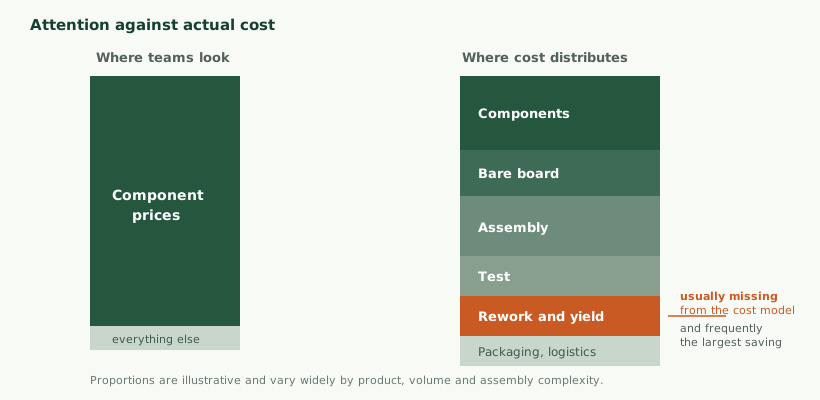
A unit cost decomposes into more elements than the bill of materials, and several of them respond better to engineering than purchasing does.
| Element | Driven by | Engineering lever |
|---|---|---|
| Components | Part selection, specification, volume | Rationalisation, removing over-specification, integration |
| Bare board | Area, layer count, finish, minimum feature size | Layout revision, layer reduction where constraints allow |
| Assembly | Placement count, number of sides, manual operations | Part count, single-sided placement, eliminating hand work |
| Test | Fixture cost, test time, coverage strategy | Design for test, choosing the right test approach |
| Rework and yield loss | First-pass yield, fault diagnosability | Design for manufacture, better test coverage |
| Packaging and logistics | Size, weight, protection required | Mechanical design, sometimes substantial |
The row worth dwelling on is rework and yield. A unit that fails test and is reworked consumes labour, diagnosis time and often a replacement component, and it may still be less reliable in the field. Because rework is usually accounted separately from unit cost, it is frequently invisible in the model altogether, and an improvement to first-pass yield can outweigh every component substitution under consideration.
The teardown
A cost reduction exercise starts with understanding what you have, which requires more than reading the bill of materials.
- The bill of materials, with current pricing at real volumes, lifecycle status for every line, and lead times.
- The board: area, layer count, finish, and whether any of those are driven by a single circuit block that could be treated differently.
- The assembly process: how many placements, how many sides, any through-hole or hand-soldered parts, any manual operations at all.
- The test process: what is tested, how, how long it takes and what it catches.
- Production data: first-pass yield, the distribution of failure modes, and rework effort. This is the most valuable input and the one most often unavailable.
- Field data: returns and their causes, which sometimes reveal that a cost decision has been paid for several times over in warranty.
From that, opportunities can be ranked by saving against effort, risk and requalification impact. The ranking matters as much as the list, because a team with limited engineering capacity should pursue the items where those four factors align rather than the largest headline number.
Getting the data you need to do this properly
A cost exercise is only as good as its inputs, and gathering them is frequently the slowest part. It is worth starting early because some of it comes from other organisations.
| Input | Usually held by | What it unlocks |
|---|---|---|
| Bill of materials with real pricing at your volumes | Procurement | Ranking component opportunities honestly |
| Lifecycle status and lead times per line | Distributor or manufacturer | Finding obsolescence risk before it bites |
| Assembly quotation breakdown | Contract manufacturer | Seeing whether placements, sides or manual steps dominate |
| First-pass yield and failure distribution | Contract manufacturer | The single most valuable input, and the hardest to obtain |
| Rework time and cost | Contract manufacturer | Quantifying the invisible expense |
| Test time per unit and fixture cost | Contract manufacturer | Judging whether the test strategy suits the volume |
| Field return rates and causes | Support or warranty | Finding cost decisions already being paid for twice |
| Design files and revision history | You | Understanding what has already changed and why |
The yield and rework rows are the ones that matter most and the ones most often unavailable, because they live with a contract manufacturer who has no particular incentive to share them. Asking clearly, explaining why, and offering to share the resulting improvements usually works better than a contractual demand. A manufacturer whose rework burden falls is a manufacturer whose margin improves, so the interests are more aligned than the conversation sometimes suggests.
Where the data genuinely cannot be obtained, it is better to say the analysis is incomplete in that area than to proceed as though assembly and yield were not variables.
Component rationalisation
This is usually where the largest and safest savings are.
Reduce the number of distinct parts. Every unique part number carries a procurement cost, a stocking cost, a feeder position during assembly and a risk of shortage. A design using several similar resistor values where one would serve is paying for that variety repeatedly. Consolidating values, standardising on fewer package sizes, and reusing parts already stocked for other products can reduce cost without changing a single price.
Remove over-specification. Parts chosen when operating conditions were unknown are frequently rated well beyond what the product actually experiences. A capacitor rated for far more voltage than it will see, a regulator specified for a current the design never approaches, a connector rated for cycles the product will never accumulate. Each was a sensible precaution at the time and each costs money now.
The discipline here is establishing what the real operating conditions are, by measurement rather than assumption, and then specifying against those with appropriate margin. The caution is that margin exists for reasons, some of them unrecorded, so removing it requires understanding why it was there.
Integrate. Where several discrete parts perform a function that a single integrated part now provides, the saving is in placements and board area as well as component cost. Silicon moves quickly, and a design that is a few years old frequently has options that did not exist when it was drawn.
Assembly, which responds well to design
Assembly cost is substantially determined by decisions in the layout, and it is often the area where engineering effort produces the most per hour spent.
- Placement count is close to a direct cost. Fewer components means less machine time.
- Number of populated sides. A board with components on one side only is meaningfully cheaper to assemble than one requiring a second pass. Where a handful of parts on the second side force that pass, moving them is worth investigating.
- Through-hole parts require a separate process or hand soldering, both of which cost far more per joint than surface mount placement. A design with a few remaining through-hole parts is paying for a whole process step.
- Manual operations. Anything requiring a person to position, adjust, glue or hand-solder is expensive and variable. Eliminating one manual step frequently saves more than a dozen component substitutions.
- Panelisation. How boards are arranged for manufacture affects both cost and the effort of separating them afterwards.
- Component orientation and spacing. Consistent orientation and adequate clearance improve placement reliability and inspection, which feeds directly into yield.
Test, and the cost of finding faults late
Test is an expense that reduces a larger expense, and the design determines how efficiently it can do that.
A board designed without test in mind is difficult to diagnose when it fails, which means faults are found later in assembly, at higher cost, or escape to the field, at much higher cost. Providing access to key nodes, making subsystems independently testable, and including a means for firmware to report internal state all reduce the cost of every fault the process encounters.
The choice of test approach interacts with volume. A dedicated fixture has a setup cost that is amortised over the production run, so it suits high volume; approaches needing no fixture suit lower volume or frequent variants. Functional testing, which exercises the product as it will be used, catches faults the others miss and is usually worth including regardless.
The figure to watch is first-pass yield. Improving it reduces rework labour, diagnosis time, replacement parts and schedule disruption simultaneously, and it is frequently achievable through design changes rather than process changes.
Firmware and cost, which are more connected than they look
Software is usually absent from cost discussions because it has no unit price. It nonetheless affects hardware cost in several direct ways, and sometimes offers the cheapest saving available because changing it triggers no requalification of the hardware.
- It can remove components. A measurement corrected in software may not need a precision reference. A characteristic linearised numerically may not need a matched pair. A filter implemented digitally may replace analogue parts, within the limits set by aliasing, as discussed in sensor selection and signal conditioning.
- It can allow a cheaper processor. Firmware that fits comfortably in a smaller part with less memory permits a lower-cost device. This is worth examining specifically, because processors are often selected early with generous headroom that the finished firmware never uses.
- It determines calibration cost. A design requiring manual adjustment during production is paying for labour on every unit. Automating calibration, or designing it out through a self-characterising approach, removes that permanently.
- It determines test time. Test duration is a real production cost, and firmware that exposes internal state and self-tests efficiently can substantially shorten it. A built-in self-test that reports a clear verdict is faster than an external sequence measuring the same things indirectly.
- It can rescue a marginal design. Adjusting timing, reducing drive strength or changing a switching frequency can resolve problems that would otherwise need a board revision, as covered in EMC and compliance.
The general point is that firmware changes are cheap to make and cheap to deploy, particularly where an update path exists, and they touch nothing that was certified about the hardware. When a cost target is proving difficult through hardware alone, it is worth asking the firmware team what the electronics is doing that software could do instead.
The board itself
Bare board cost is driven by area, layer count, and the manufacturing capability required.
Area is straightforward: smaller costs less, and more boards fit each panel. The constraint is that reducing area increases routing density, which may push layer count up or require finer features, either of which can cost more than the area saved. The optimum is not obvious and is worth calculating rather than assuming.
Layer count is a significant step change. Removing a layer pair can be a substantial saving, and it is sometimes achievable through better routing or by relaxing a constraint that turned out not to matter. The caution is that reference planes serve an electromagnetic purpose as well as a routing one, and removing a plane to save cost can create an emissions problem that costs far more to resolve; see EMC and compliance.
Manufacturing capability, meaning minimum track width, spacing and hole size, affects which suppliers can build the board and at what price. A design using the finest features a supplier offers pays a premium and reduces the field of alternatives. Relaxing those where the circuit does not require them widens the supplier base and lowers cost.
Working with your contract manufacturer
The assembler knows things about your product that you do not, and the relationship determines whether that knowledge reaches you.
They see which components are awkward to place, which joints fail inspection, where operators slow down, which parts arrive on reels that jam, and which step causes most of the rework. None of that appears in a quotation, and most of it is available simply by asking someone who watches the line.
A few questions that consistently produce useful answers:
- Which part of this assembly costs you the most time? Frequently not what you would guess.
- What would you change about the design if you could? Assemblers usually have a list and are rarely asked for it.
- Which joints or components generate most inspection failures? This points directly at yield opportunities.
- Are any parts difficult to source or frequently substituted? They may know of availability problems before your procurement does.
- Would a different panel arrangement help? Often a free improvement.
- What would let you drop a process step? Removing a whole step is worth more than optimising several.
It is worth being honest about the incentive structure. A manufacturer paid per unit assembled has limited reason to propose changes reducing their own revenue, and one paid for rework has even less. Where a relationship allows it, sharing the benefit of improvements aligns those incentives and turns the assembler into a source of ideas rather than a supplier of quotations.
The same applies to visiting. An hour watching your product being built produces observations that no amount of reading the documentation will, and it is a remarkably underused way to find cost.
Supply resilience, which is cost by another name
Recent years have made this a first-order concern rather than a procurement detail.
Single sourcing is both a cost and a risk. It removes negotiating position and leaves nothing to fall back on. Identifying and qualifying a second source for critical parts is work that pays off in both directions, and it is best done while the design is stable rather than during a shortage.
Lifecycle status should be reviewed periodically for every line in the bill of materials. Parts move to not-recommended-for-new-design and then to obsolete on timescales that are visible in advance, and a design reviewed annually is rarely surprised. One reviewed only when a part becomes unavailable is always surprised.
When a part does go end of life, the options are a last-time buy covering expected demand, a drop-in replacement if one exists, or a redesign of that circuit block. Each has different cost and risk, and the right answer depends on remaining product life and on what the substitution would trigger. A last-time buy is a legitimate choice that buys time for a planned redesign rather than an emergency one.
Designing for replaceability helps: choosing parts with multiple manufacturers, avoiding unnecessary reliance on a unique feature, and keeping the circuit around a part conventional enough that alternatives fit.
Mechanical and packaging, which are often overlooked
Electronics attracts the attention, and for many products the enclosure, packaging and logistics carry a comparable or larger share of cost.
- Enclosure process. Moulded parts have high tooling cost amortised across volume; machined or fabricated parts have low tooling and high per-unit cost. A product whose volume has grown substantially since launch may be using the wrong process entirely, and the crossover is worth recalculating rather than assuming the original choice still holds.
- Part count and fasteners. Every screw is a part, a placement and an assembly operation. Integrated features that replace fasteners reduce all three, at the cost of tooling complexity.
- Finish and cosmetics. Requirements inherited from an early specification are worth revisiting, since some cosmetic constraints turn out to matter to nobody.
- Packaging. Sized for protection during transport, which is frequently over-specified because nobody tested the lower bound. Drop testing a reduced package is cheap and can produce a real saving on every unit, including in shipping volume.
- Shipping dimensions. A small reduction that moves a product into a lower freight band or allows more units per pallet has an outsized effect, and it is a mechanical decision rather than an electronic one.
For products where the electronics is a modest portion of the whole, starting here rather than with the bill of materials is frequently the faster route to a result.
The changes that need no requalification
Because requalification is what turns savings into costs, it is worth separating out the opportunities that avoid it entirely. These are the first place to look, and they are often overlooked because they feel less like engineering.
- Second sourcing an identical part from another distributor or manufacturer, where the specification and behaviour are genuinely equivalent, with sample verification.
- Consolidating part numbers across products, which increases purchasing volume on fewer lines without changing any design.
- Renegotiating on the basis of accurate forecasts. Suppliers price against uncertainty, and a firmer commitment frequently earns a better position.
- Reducing packaging, subject to transport testing.
- Improving assembly process rather than design: better fixturing, adjusted placement order, improved feeder arrangement. These belong to the manufacturer but can be prompted.
- Eliminating a manual inspection step that automated test already covers.
- Fixing a yield problem caused by process rather than design.
None of these touches the certified configuration, which means they can be implemented quickly and carry little risk. It is worth exhausting this list before considering anything that requires a board revision.
What a change triggers
This is the consideration that turns an apparent saving into a real one or into a mistake.
| Change | May affect | Typically requires |
|---|---|---|
| Passive component value or package | Little, if ratings are preserved | Verification that it behaves as expected |
| Different manufacturer, same specification | Tolerance and behaviour at extremes | Sample testing across the operating range |
| Switching regulator substitution | Thermal behaviour, emissions | Thermal verification, EMC assessment |
| Layout revision | Emissions, signal integrity, thermal | EMC reassessment, likely retesting |
| Connector change | Mechanical fit, retention, safety distances | Mechanical and possibly safety review |
| Enclosure material or construction | Ingress rating, thermal, shielding, safety | Reassessment against the relevant requirements |
| Firmware-visible part change | Software behaviour | Firmware work and a field update path |
| Anything in a safety-related function | Safety assessment | Formal reassessment; treat as a separate exercise |
We assess these before recommending a change. A modification that saves a little per unit and costs a full requalification cycle is not a saving, and saying so is part of the job.
Counting the whole cost, not the unit cost
A change that reduces the price of building a unit can increase what the product costs the business, and unit cost on its own will not show it.
A component with a marginally worse failure rate produces field returns, each of which carries diagnosis, replacement, shipping, administration and a reputational cost that nobody invoices. A part with longer lead times increases the inventory that must be held. A design change that raises test failures consumes capacity as well as labour. A substitution that makes the product harder to repair raises support cost for its whole life.
None of these appear in a bill of materials comparison, and all of them are real.
The practical response is not a full lifecycle costing exercise for every decision, which would be disproportionate, but a habit of asking one question before each change: what else does this touch? Usually the answer is nothing and the change proceeds. Occasionally it surfaces a consequence that outweighs the saving, and catching one of those pays for asking about all the others.
It is also worth watching the aggregate. A programme that makes twenty small changes, each individually defensible, can shift a product’s reliability without any single decision being wrong. Tracking return rates and test yield across the programme rather than only per change is what catches that drift.
Volume changes the answer
Whether an opportunity is worth pursuing depends on how many units it applies to.
At low volumes, engineering effort dominates and most component-level optimisation does not repay the work. What remains worthwhile are changes that reduce risk rather than cost: second sourcing, addressing parts approaching end of life, and eliminating manual operations that introduce variability.
At medium volumes, assembly and test improvements start to pay, and part rationalisation becomes worthwhile because procurement and handling costs are real.
At high volumes, everything is on the table, including board area, layer count and tooling changes that would be indefensible at lower quantities. This is also where yield improvement produces the largest absolute returns, because a small percentage applies to a large number.
The useful question before starting is: how many units will this change apply to over the remaining product life? That number, multiplied by the per-unit saving and compared against the engineering and requalification cost, gives a defensible answer, and it frequently rules items in or out that intuition had placed on the other side.
Running the programme without breaking the product
A cost reduction exercise introduces risk into a product that currently works, which is a genuinely uncomfortable position and needs managing deliberately.
Change one thing at a time where you can. Bundling five changes into one revision is efficient and means that when something behaves unexpectedly you cannot tell which change caused it. Where bundling is unavoidable, at least sequence the verification so each change can be assessed.
Build and test a pilot batch. Not one unit. A small production run reveals variation that a single carefully assembled sample does not, and variation is exactly what a component substitution can introduce.
Test at the extremes, not the middle. A substituted part that behaves identically at room temperature may differ at the limits of the operating range, and cold starts in particular reveal differences that nothing else does.
Keep the old configuration available. Until the new one has run in volume for long enough to be confident, being able to revert is worth the inventory it costs.
Track field performance afterwards. Some consequences appear only after months in service. A change made to save cost that raises the return rate has lost money, and you will only know if somebody is watching.
Record the reasoning. Why each change was made, what was verified, and what was decided not to change. The next person to look at this product will otherwise repeat the analysis, and may undo a decision that existed for a reason.
Where to be conservative
Some areas repay caution more than others. Anything in a safety-related function should be treated as a separate exercise with its own assessment rather than swept into a cost programme. Parts whose failure mode is dangerous rather than merely inconvenient deserve their margin. Components in circuits that took a long time to get working are frequently carrying tolerances nobody documented. And anything that was changed once before, and then changed back, almost certainly has a history worth uncovering before it is changed again.
A worked example
An established product, several years into production, volumes higher than originally planned, and a component that has just been announced as end of life.
The obsolescence forces attention, which is a good moment to look wider. A teardown finds: the end-of-life part has a pin-compatible alternative from a second manufacturer, requiring sample testing rather than redesign. The board carries several hundred placements, including a dozen parts on the second side that force a second assembly pass, most of which could be relocated. Sixty distinct part numbers include eleven resistor values that could be consolidated to five. Three capacitors are rated for several times the voltage they see. First-pass yield is lower than it should be, with most failures concentrated on one connector that is difficult to place consistently.
Ranked by saving against effort and risk, the order is roughly: consolidate resistor values and remove over-specified capacitors, which require verification only; address the connector placement problem, which improves yield and needs no requalification; relocate the second-side components, which is a layout revision and therefore triggers an EMC assessment; and qualify the second-source part for the obsolete component.
Note what is not on the list: negotiating better prices. That conversation may be worth having, but it is a procurement exercise rather than an engineering one, and it rarely produces what the items above do.
Designing a new product so this is easier later
Most of this article concerns products that already exist. If you are designing one now, a few decisions make the eventual cost exercise far cheaper, and none of them costs anything at design time.
- Record why every specification exists. A note explaining that a capacitor is rated high because of a measured transient is worth a great deal later. Without it, somebody will either remove the margin and cause a failure, or leave it in perpetuity out of caution.
- Prefer parts with multiple manufacturers from the start. It costs nothing at selection and removes an entire category of future problem.
- Keep the distinct part count low from the beginning. Standardising on a small set of values and packages is easier to do once than to retrofit.
- Design for test from the outset. Test access added later is awkward; designed in, it is free.
- Avoid unnecessary manufacturing constraints. Using the finest features available because the tool allowed it narrows your supplier options permanently.
- Leave the layout some room. A board packed to its limits cannot absorb a component substitution with a different footprint.
- Separate the circuit blocks that are likely to change. A connectivity module or a sensor interface that is self-contained can be revised without disturbing the rest.
The underlying idea is that a first design should anticipate being revisited, because successful products always are. Our article on taking an idea to a working prototype covers the earlier stage, and prototype to production the transition into volume.
Mistakes worth avoiding
- Optimising the bill of materials alone. Assembly, test and yield are frequently larger.
- Ignoring rework cost. It is usually accounted elsewhere and often exceeds the savings under discussion.
- Removing margin without understanding why it was there. Some of it is load-bearing.
- Substituting a part without testing at the extremes. Equivalent on paper is not equivalent in a cold start.
- Treating a layout revision as free. It is the change most likely to trigger retesting.
- Cheaper parts with worse availability. A shortage costs more than the saving.
- Not reviewing lifecycle status until something is unavailable. It is visible in advance.
- Changing several things at once. When something behaves unexpectedly, you cannot tell which change caused it.
How we help
- Cost teardown. Analysing bill of materials, board, assembly and test against what the product actually has to do, ranked by saving, effort, risk and requalification impact.
- Component rationalisation. Alternates, second sources, and genuine over-specification, with the reasoning recorded rather than assumed.
- Design simplification. Consolidating functions, reducing part count, removing circuitry that history shows is unnecessary.
- Layout revision. Area and layer reduction where the constraints allow. See hardware and PCB design.
- Design for manufacture and test. Faster assembly and earlier fault detection, which usually repays more than substitution.
- Obsolescence response. Assessing replacements and what each one forces.
- Requalification planning. Working out what testing each change triggers, before you commit to it.
The service page for this work is product cost reduction and redesign, and the transition into volume production is covered in prototype to production.
When cost reduction is the wrong project
Occasionally the right recommendation is to stop, and a supplier who never says so should be treated carefully.
When the product is near end of life. Engineering effort recovered over a shrinking remaining volume rarely pays. A last-time buy and a graceful wind-down may be the better answer.
When the real problem is elsewhere. A product losing money because of warranty returns, support burden or slow assembly has a quality or process problem, and shaving the bill of materials addresses none of it. Establishing where the money is genuinely going comes before deciding what to optimise.
When a redesign would serve better. A design several generations behind the available silicon may be cheaper to replace than to optimise, particularly where integration has moved on substantially. That is a larger decision with its own risks, but it should at least be compared rather than assumed away.
When the volume does not justify it. The arithmetic is simple and frequently unwelcome: engineering cost divided by remaining units, against saving per unit. If that does not work, it does not work.
When capacity is the constraint. If you cannot make enough to meet demand, effort spent reducing unit cost may be better spent removing the constraint, which frequently means assembly or test time rather than component cost. Finding where that capacity actually goes is the subject of measuring OEE and energy.
A short glossary
| Term | Meaning |
|---|---|
| Bill of materials | The list of every component in a product, with quantities and part numbers. |
| First-pass yield | The proportion of units passing test without any rework. The figure that most influences hidden cost. |
| Rework | Correcting a unit that failed test. Labour, diagnosis and parts, usually accounted separately from unit cost. |
| Design for manufacture | Designing so the product can be built quickly and consistently, rather than only so it works. |
| Design for test | Designing so faults can be detected efficiently, through access, partitioning and self-reporting. |
| Placement | One component positioned by an assembly machine. A close proxy for assembly cost. |
| Panelisation | Arranging several boards on one manufacturing panel, and how they are separated afterwards. |
| Second source | An alternative manufacturer for a component, qualified in advance rather than during a shortage. |
| Last-time buy | Purchasing remaining stock of a component being discontinued, to cover expected demand. |
| Requalification | Retesting required because a change may have affected a characteristic that was previously verified. |
| Over-specification | A component rated well beyond the conditions it will actually experience. |
If you take one thing away
The instinct when asked to reduce cost is to open the bill of materials and look for expensive lines. That is the smallest lever in the system and the one most likely to introduce risk for modest return.
The larger levers are how many distinct parts you buy, how many operations the assembly requires, how many units need rework, and whether the design forces manufacturing decisions that cost money for no functional benefit. Those are engineering questions, they respond to engineering effort, and most of them carry less risk than substituting a component.
And before any of it, establish what each change would trigger. A saving that requires a full requalification cycle has to be large to be worth it, and knowing which side of that line an idea falls on is what separates a cost programme that improves margin from one that quietly consumes a year. Who owns the design and tooling, and what that means for your options, is covered in choosing a development partner. The transition from prototype to volume, where many of these decisions are first tested, is covered in prototype to volume production. For the wider systems this hardware ends up serving, see what industrial IoT actually is.
Questions we are asked about this
What clients ask before starting
How much can we expect to save?
That cannot be answered responsibly before looking at the design. After a teardown we give a ranked list of opportunities with estimated saving, engineering effort, risk and any requalification each triggers, so you can decide what is worth pursuing.
Where does the saving usually come from?
Rarely from negotiating component prices. More often from reducing the number of distinct parts, removing over-specification, simplifying assembly, and improving first-pass yield. Assembly and test costs are frequently a larger opportunity than the bill of materials.
Will changes mean retesting the product?
Possibly, and that is assessed before anything is recommended. A layout revision can affect emissions and may require retesting. A saving that triggers a requalification cycle is often not a saving at all, and we will say so.
A component has gone end-of-life. Can you help?
Yes. That covers assessing candidate replacements, understanding what each changes electrically, thermally and mechanically, and identifying what testing the substitution requires. Sometimes the honest recommendation is a last-time buy while a proper redesign is planned.
At what volume does this become worth doing?
It depends on the saving per unit against the engineering cost, and on whether the change also reduces risk. A supply-resilience change can be worth making at any volume, whereas shaving a small amount from a board is only worth it when the unit count justifies the work.
Can you reduce cost without changing the design?
Sometimes, through second sourcing, consolidating part numbers across products, or packaging and logistics changes. These avoid requalification entirely, which makes them the first place to look.
Is a cheaper component always a saving?
No. A part that is marginal on rating, has worse availability, or increases test failures can cost more overall than the difference in purchase price. The comparison has to include yield, warranty and supply risk rather than only the line item.
Can you do this on a product you did not design?
Yes, and it is the usual case. We work from the existing design files, the bill of materials and, where possible, physical samples and production yield data.
What are you building today?
Tell us roughly what the product is, your current volumes, and whether the pressure is margin, a part going end-of-life, or supply reliability.